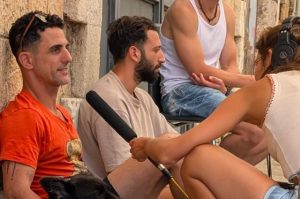
Eleven years ago, while working on an episode that marked the twentieth anniversary of Prime Minister Yitzhak Rabin’s assassination, we called his little sister Rachel – ninety-year-old at the time – and asked if we could come talk to her about her childhood memories. She agreed and invited us to her Kibbutz – Manara, in the Upper Galilee, literally on the border with Lebanon. We spent an entire afternoon with her, and came out of her humble home feeling as if I had just touched history. On Friday she passed away, at 101.
As a way to say goodbye and celebrate her long and meaningful life, we bring you a tiny taste of the afternoon we spent with Rachel Rabin Yaakov back in 2015.
Act Transcript[Phone rings]
Rachel Rabin Yaakov: Shalom.
Mishy Harman: Shalom, Rachel?
Rachel Rabin Yaakov: Ken.
Mishy Harman: Ken, shalom, medaber Mishy Harman.
Rachel Rabin Yaakov: Ken.
Mishy Harman: Ma shlomech?
Rachel Rabin Yaakov: Beseder.
Mishy Harman (narration): Rachel Rabin, Yitzhak Rabin’s little sister, isn’t so little anymore. She’s almost 91, and she lives – alone – at the very edge of the country, in Kibbutz Manara, less than a hundred meters from the border with Lebanon. She had told us to call when we got to the entrance of the Kibbutz, so that she could direct us to her house. Somewhat embarrassingly, and even though there are only like two-and-a-half streets in the whole place, we got lost.
When we finally pulled into her driveway, she looked at us and with half a smile said, “guys, you… you really screwed up, huh?”
You wouldn’t guess her age if you saw her. She has a quick step, a long white braid, and a young voice. But the main thing you notice about her, immediately, is that she looks exactly like her brother.
She gave us some coffee, and slices of an apple pie she had made. We sat in her tiny apartment, and – as if we were talking about yesterday – Rachel took us back to the early 1930s in Tel Aviv.
Rachel Rabin Yaakov: Our parents were always very busy, so we were alone a lot of the time. And somehow Yitzhak always felt that he was responsible for me. That he needed to take care of me. To protect me. And that’s how I felt. Till his last day, really, I felt he was protecting me, even from afar. One day, I remember, we went to see a movie. That was a big deal in those days. And I cried my eyes out. And Yitzhak, he said to me, “I’m never gonna take you to the movies again. The film’s barely started and you’re already crying. Even if it’s not sad!” So I said, “OK, I promise not to cry at the movies anymore.”
Mishy Harman (narration): Even though we know that our leaders were all just once normal kids, it’s kind of funny to imagine a national icon like Rabin going to a school dance and waiting sheepishly for some girl to smile at him.
Rachel Rabin Yaakov: Yitzhak was a shy kid. Closed. Very quiet. You know, one of those ‘don’t touch me and I won’t touch you’ kind of kids. He wasn’t one of the popular, or loud, kids. But he was a good athlete, from the beginning. He was good at soccer, and his friends would come over to play soccer in the street. They didn’t want me to bother them, so they’d make me the goalie.
Mishy Harman (narration): We spent about three hours with Rachel, and – I’m gonna say that I’ve never been with anyone who receives as many phone calls as she does. There were journalists, of course, old friends of Yitzhak calling to check in on her, neighbors, grandchildren, and – I kid you not – someone who called to say that had gone to the same summer camp as Rachel in 1935, and wanted to know whether she remembered the words to the camp anthem. She did.
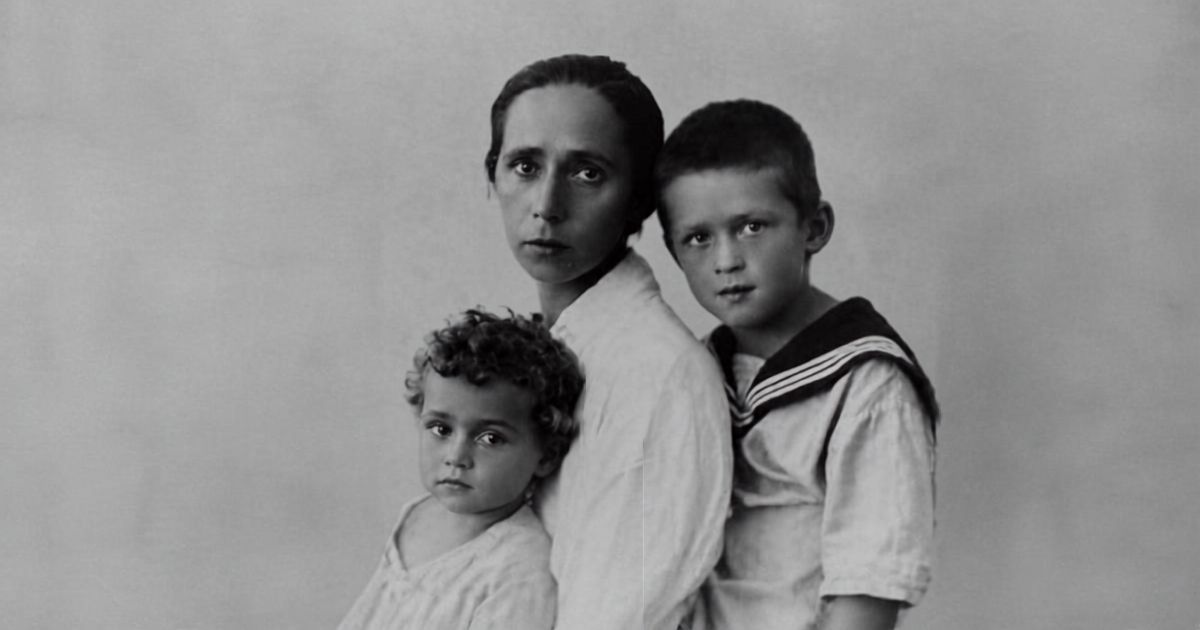
Before we left, Rachel took us to the den, where she keeps all her memorabilia. She pointed to the wall, to a large faded picture of their mom, Roza, holding her two kids, five-year-old Yitzhak, in sort of a blue-and-white sailor’s outfit, and two-year-old Rachel, with short curly hair. She showed us part of a Katyusha bomb that landed in her living room, and then she opened folders, where – in individual plastic sheets – she keeps dozens and dozens of letters from Yitzhak. She took out a few, and as she began reading them to us, I thought about what it’s like to share your big brother with an entire country. To have so many people feel as if they had a special relationship to him, even though they never even knew him, let alone fought with him about who would do the dishes. Rachel talks about her big brother with admiration, and respect. And from all his letters you can tell just how much he loved her too. But – like all of us – even with her there’s a sense that something wasn’t completely equal. In the sixties, once her brother had already become a war hero and a public figure, he was on the radio, talking about his childhood.
Rachel Rabin Yaakov: My dad and I sat here in the living room and listened to the show. And Yitzhak was talking about how lonely he felt at home, growing up. And I was really surprised, since I never felt lonely. So I called him up afterwards, and we tried to understand why we had such different memories. And then I realized that I was never lonely because I had him. He was always around. And I guess I just wasn’t the same kind of rock for him as he was for me. I was just his little sister. I just miss him so much.
Our end song is BaGalil (“In the Galilee”) by Arik Einstein.
The episode image is courtesy of the Israel National Photo Collection.