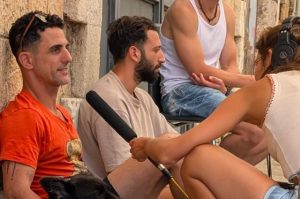

Today is Tu Be’Av, the Jewish calendar’s version of Valentine’s Day. And, after a long hiatus in releasing new English episodes – a period during which we’ve been diligently working on all our local Jerusalem-based storytelling events and a whole slew of new shows in both English and Hebrew that are coming your way very soon – we thought that Tu Be’Av, and more generally love, are as good an excuse as any to break our silence. So here we are, back in your ears. A while back, a bunch of us were in the office, sitting around our beautiful pine-wood table and talking about dates: Unusually awkward ones, surprisingly good ones, total catastrophes and blissful delights. As the conversation went on, we were reminded of what we all intuitively know – that dates are, and will forever be, fine fodder for stories. So set the table – we have a full menu of stories of (very!) Israeli dates.
We decided to host a first date in our studio. But who, in their right mind, would subject themselves to a date that’s not only watched by half our staff, but also recorded for posterity?
Act TranscriptMishy Harman (narration): So it’s Tu Be’Av, the Jewish calendar’s version of Valentine’s Day. And, after a long hiatus in releasing new English episodes – a period during which we’ve been diligently working on all our local Jerusalem-based storytelling events and a whole slew of new shows in both English and Hebrew that are coming your way very soon – we thought that Tu Be’Av, and love, are a good excuse to break our silence. So here we are, back in your ears. I’m Mishy Harman, and this – of course – is Israel Story. Our episode today? It’s a Date!
A while back, a bunch of us were in the office, sitting around our beautiful pine-wood table and talking… about dates. Unusually awkward ones, surprisingly good ones, total catastrophes and blissful delights. As the conversation went on, we were reminded of what we all intuitively know – that dates are, and will forever be, fine fodder for stories. Someone suggested we make a date episode, and one of our interns at the time – the ever inventive Shira Shanskhalil – chimed in with a development on the theme. “Why,” she asked with a mischievous twinkle in her eye, “don’t we host a blind date right here in our studio?”
“OK,” I said, not thinking this idea would actually go anywhere. I mean who in their right mind would subject themselves to a date that’s not only being watched by half of our staff, but also being captured on tape for all our listeners around the world?
Well…
Shira said she knew someone who might be game.
And who, exactly, I wondered, would be her date? Since we were all spoken for, the task fell to our somewhat intrigued and somewhat horrified American, single and Larry David-esque intern, Mr. Lev Cohen.
Lev Cohen: My name is Lev and apparently, someone, some fine young lady, has been invited to the studio to have the privilege of a first date with me. God bless her.
Mishy Harman (narration): Shira worked her magic and set up the date. The production team splurged on a bottle of red wine and some heart-shaped chocolates, and we all crammed into the studio, ready for our voyeuristic experience. Esther, that’s the young lady’s name, was late – she’d later claim that she got off at the wrong bus stop – so as we were waiting, a bunch of us took the opportunity to grill Lev about his dating life.
Mishy Harman: Are you excited?
Lev Cohen: Ummm… Wouldn’t be the first word to come to mind, but it also wouldn’t be the last. So…
Adina Karpuj: What would be the first word?
Lev Cohen: Ummm… weirded out. I guess that’s two words. Adina Karpuj: What number first date would you say this is to you?
Lev Cohen: Ummm… Maybe, like, fortieth?
Adina Karpuj: Wow, so you have some experience in the field.
Lev Cohen: In first dates [laughter]. Fewer in second dates.
Mishy Harman (narration): I should mention that Lev was 22-years-old at the time, fresh out of college, and on a gap year before going to law school. Once he heard that high number, our producer Jamal Risheq – a Palestinian Jerusalemite who’s only a few years older than Lev – had a pressing question to ask.
Jamal Risheq: OK, now tell me, what would attract you in a girl?
Mishy Harman (narration): Lev began giving him a learned, if somewhat bland, answer, the kind of boilerplate response about the desired combination of good looks and a good character. But Jamal was oddly concerned with one, very specific, physical attribute.
Jamal Risheq: Because I can’t handle a girl with ugly feet, for example.
Lev Cohen: Ugly feet?
Jamal Risheq: Ugly feet, yeah. Like if you can see the bones or like it would look like a skeleton. This is… like terrible.
Mishy Harman (narration): There was a bit more discourse along these lines, with Lev fretting about his own feet and Jamal’s perception of them, and then – finally – we heard a knock on the studio door.
[Knocking]
Jamal Risheq: OK, your date is here.
Lev Cohen: Yalla.
Jamal Risheq: OK, and yellow teeth, by the way.
Lev Cohen: Great.
Mishy Harman (narration): Neither Lev nor Esther had seen a picture of the other, and there was a pregnant second in which they were each checking the other one out.
Esther Chen: OK…
Lev Cohen: It’s a good start.
Esther Chen: Ken, mamash normal situation.
Lev Cohen: Yeah.
Esther Chen: Comfy and normal…
Mishy Harman (narration): We all disappeared into the adjacent control room and gave the two love birds some privacy, well… recorded privacy that is. They began by asking each other some of the usual start-of-a-first-date questions and setting some expectations for this very unusual encounter.
Lev Cohen: I have one expectation which is to learn what your name is?
Esther Chen: OK, Esther Chen. It’s two names, OK?
Lev Cohen: Esther Chen?
Esther Chen: Ken, what your name?
Lev Cohen: My name is Lev.
Esther Chen: Lev?
Lev Cohen: Yeah.
Esther Chen: Like heart?
Lev Cohen: Like heart.
Esther Chen: Yay.
Lev Cohen: But it’s also like lion.
Esther Chen: Lion?
Lev Cohen: In Russian.
Esther Chen: Wow!
Lev Cohen: Like Aryeh. I prefer that one, you know? It’s…
Esther Chen: Lev?
Lev Cohen: It’s a little more fierce.
Esther Chen: Yeah. Not like weak, OK.
Lev Cohen: You think hearts are weak?
Esther Chen: Nooooo. Heart is the best. Heart is everything.
Lev Cohen: Yeah.
Mishy Harman (narration): Firmly staying within the boundaries of conventional first-date-banter, Lev inquired.
Lev Cohen: So how do you know Shira?
Esther Chen: How I know Shira? So she’s friend of my friend…
Lev Cohen: Emm hmm.
Esther Chen: That learn with me at high school. And this friend fly to Philadelphia…
Lev Cohen: I’m from Philadelphia.
Esther Chen: Wow.
Lev Cohen: See, it was meant to be.
Mishy Harman (narration): The random Philadelphia connection seemed to create a bit of an early spark.
Lev Cohen: So you did not grow up in Philadelphia like I did.
Esther Chen: No. I…
Lev Cohen: Where did you grow up?
Esther Chen: I grow up in Gush Katif. You know Gush Katif?
Lev Cohen: I don’t…
Esther Chen: OK so…
Lev Cohen: Pretend I know… I know nothing about Israel, because it’s basically true.
Esther Chen: OK, so it’s like, you know Azza?
Lev Cohen: I know Azza.
Esther Chen: OK, so there. Stam… Ehh… It’s… It’s…
Lev Cohen: Wow, you were… you were talking… talking shit on Philadelphia but you grew up in Azza.
Esther Chen: [laughter] OK, no, it was like a some area, it was belong to Israel.
Lev Cohen: Emm hmm.
Esther Chen: It’s called Gush Katif, near the sea, a really beautiful area. And then Israel give it to Falastine.
Lev Cohen: Wait so it… so it is in Gaza?!
Esther Chen: No, so now it’s Azza.
Lev Cohen: Yeah.
Esther Chen: But before it was my home.
Lev Cohen: Wow, so… Wait.
Esther Chen: So Israel expel all the…
Lev Cohen: Yeah, so you were one of the people who were expelled?
Esther Chen: Yeah.
Lev Cohen: Oh my god!
Esther Chen: I’m expelled from there.
Lev Cohen: How old were you? Like five?
Esther Chen: Five years old. Yeah…
Lev Cohen: Whoa, that’s insane.
Esther Chen: Yeah it’s really sad.
Lev Cohen: You should have told me that before you told me your name!
Esther Chen: Ehhh, no!
Mishy Harman (narration): Soon afterwards they segued into a game called “36 Questions to Fall in Love” while nibbling on the vegan snacks and sipping the Gamla wine, breaking – in the process – all our studio rules. After that initial excitement, things cooled down a bit…
Lev Cohen: For what in your life do you feel most grateful?
Esther Chen: Oh, me?
Lev Cohen: Can we skip this one?
Esther Chen: No, my family!
Lev Cohen: This is cringe.
Esther Chen: No, my family…
Lev Cohen: OK, sure, my family too. OK…
Esther Chen: OK, next…
Mishy Harman (narration): Then things continued to be rocky
Lev Cohen: How do you feel about like having kids?
Esther Chen: I want!
Lev Cohen: How many?
Esther Chen: How many? Seven?
Lev Cohen: Seven?!
Esther Chen: Six?
Lev Cohen: OK, dati, dati, dati.
Esther Chen: Stigmati.
Lev Cohen: Stigmati, stigmati…
Mishy Harman (narration): After Lev called Ester “religious” and she said he was “full of stereotypes,” they moved to what felt like safer territory.
Lev Cohen: Who’s your favorite character in the Purim story?
Esther Chen: Esther.
Lev Cohen: So basic. I like Haman.
Esther Chen: It’s my name!
Lev Cohen: I like Haman.
Mishy Harman (narration): To be fair there were moments of healthy tension and earnest camaraderie throughout the nearly two hours they spent together. But mostly the raw magic of meeting someone entirely new, someone willing to bare a bit of themselves for the chance of love, ended with a hefty dose of fatigue and a thin whimper.
Esther Chen: Yay!
Lev Cohen: Shkoyach… Shkoyach…
Mishy Harman (narration): They thanked one another and retired to their corners, parting ways, seemingly for good. There were, we later learned, some follow up messages, but that awkward night in our studio has probably faded, to a large extent, from their respective memories.
Hagar Yanai and Eran Ben Yaakov chose to reinvent the familiar plot structure of dating, mating and procreating. With true love – and what might seem like a bit of genetic science fiction – their family is proof that writing one’s own romance need not remain solely in the realm of fantasy.
Act TranscriptHagar Yanai: I was born in a kibbutz, Kibbutz Barkai, and I experienced the old way of kibbutz life. And I grew up in a children house, not in my parents’ house. Never had a shower or a dinner or I never slept in my parents’ house.
Marcy Brink (narration): That’s Hagar. Hagar Yanai. She’s 54, lives in Raanana and spends her days with words. She writes, critiques, edits and teaches creative fiction. Many see her as the high-priestess of Israeli science fiction – her Leviathan of Babylon trilogy for teens was a three-time winner of the prestigious Geffen Award for sci-fi and fantasy fiction.
But she herself thinks that her love for stories, and all the creative imagination that later spilled out of her and onto the page, were already present in that Bet Yeladim on Kibbutz Barkai.
Hagar Yanai: The other children were my best friends and my worst enemies. I remember storm nights, thunder nights, where we all stayed together – all 12 children – we stayed at the same room, comforting each other and sleeping in each other beds. And I used to tell everyone stories, because I was the best reader of the whole children house. And I used to take many books from the library and I read them Tarzan, I remember. They loved Tarzan and they loved Karl May books. But also it’s really, really difficult to grow up surrounded just with children. They expected us to be a separate society, separate from the grown-up worlds, and it’s very intense having nowhere to hide. It’s not easy.
Marcy Brink (narration): Growing up, Hagar only saw her parents for a couple of hours a day, but that – she now feels – wasn’t necessarily such a bad thing.
Hagar Yanai: My mother was a Holocaust survivor and also my father and I don’t know if that had to do with that, but we had a not such a good example of seeing intimate relationship between father and mother so everything was pretty much fucked up.
Marcy Brink (narration): Her two sisters were both teenagers by the time she was born, and her parents were both very distant. So the entire notion of ‘family as a social unit’ was basically foreign to her.
Hagar Yanai: No family events or birthdays or dinners or anything like that. We just had dog and cats so the family life was like around the animals, but that’s it.
Marcy Brink (narration): So I guess it isn’t that surprising that after her army service she found herself drawn to all kinds of different, and well… alternative, modes of living.
Hagar Yanai: I had a keen interest in spiritual ways, spiritual ways of living.
Marcy Brink (narration): This took her to an anthroposophic community in Kibbutz Harduf and from there to Japan, where she worked as a hostess at a nightclub.
Hagar Yanai: Which was wonderful. It was absolutely the best life I ever lived. I worked in Ginza Quarter, which is the most expensive quarter, and also when I was bored there I went to other clubs in Shinjuku, and I went to really wild places where the Filipino girls worked and we had a lot of fun there. It was really wonderful times.
Marcy Brink (narration): Alongside all that fun, she also began a spiritual journey into the world of Zen Buddhism.
Hagar Yanai: When I was in Tokyo I lived in a little Zen community in the small city of Cheeba. And after that I went to a real monastery in a… named Shokoji in the isle of Kiushu, the south of Japan, and had quite an affair there. And that happened, yes.
Marcy Brink (narration): The affair, with the head abbot of the monastery, the so-called Master of Zen, would later become the core of her first novel, A Woman in Light.
Hagar Yanai: Young girl very determined to do something bad. And young, quite young, head of monastery. We had an affair the way people have affairs… when they’re young and stupid and not so stable in their lives and that was very dramatic but it didn’t end very well.
Marcy Brink (narration): And that’s putting it mildly – they were each essentially forced to flee both the monastery and the country.
But while all this drama took place in far-away East Asia, here in Israel, Eran Ben Yaakov was going through some love-life turbulence of his own.
Eran Ben Yaakov: I met my first wife when I was actually in the army. And after… it’s like we’ve been together for eight years or something like that and then we had our first child. But, you know, we came apart. So when we were thirty we were really different persons and we decided to separate.
Marcy Brink (narration): There was nothing in his past, or his upbringing in Beer Sheva, that would have led him to believe he’d experience such marital problems.
Eran Ben Yaakov: I come from a very boring family, we have like… my father and my mother are still together after… after fifty and some years, we had many family dinners and we are more likely to hang out together and… Yeah.
Marcy Brink (narration): The eldest of three children, Eran did well in school, went to the army, served as an officer, and then enrolled in university, where he studied psychology and cinema. Though his marriage didn’t last, he was on a roll, at least professionally. Right out of film school he landed a job writing screenplays and directing movies, and documentaries, and reality TV shows.
He lived in Tel Aviv, went out on many dates, and co-raised his young daughter, whom he calls…
Eran Ben Yaakov: One of the world’s wonders.
Marcy Brink (narration): Things seemed to have a rhythm. Life was… working. Till one day, his kindergarten “world wonder” said something that stirred things up.
Eran Ben Yaakov: My daughter told me, “if I will have brothers and sisters…” Not when I will have brothers and sisters. If I will. And that sentence actually kind of injured my heart, because I wanted her to have.
Marcy Brink (narration): So he got serious. He looked and he looked and then one day, at a conference in Tel Aviv, he saw a woman in an elegant aquamarine dress. And though she was busy talking about sci-fi, her favorite genre, she noticed him, too.
Hagar Yanai: There was this guy there. Very charismatic guy.
Marcy Brink (narration): But more than a prospective date, she thought he might be a useful contact, maybe even a potential funder.
Hagar Yanai: I thought he’s actually from the Israeli Foundation of Film. And I thought he actually might give me some budget for an idea I had for movie.
Marcy Brink (narration): That, however, was less what Eran had in mind.
Eran Ben Yaakov: This woman comes to me and start talking to me and while she’s introducing herself, I’m looking at her. She had these beautiful green eyes and I thought to myself, ‘wow, that’s like an amazing… who is this amazing woman?’
Marcy Brink (narration): Eran was trying to be charming, which – frankly – put the whole exchange in familiar territory, as far as Hagar was concerned.
Hagar Yanai: I had actually many suitors at that times. I had many many options and choices, but I didn’t want anyone because all men seemed to be so full of themselves. And the more successful and interesting they were, the more full of themselves they were. It was actually very very difficult to find a man who was both interesting and successful and able to listen and to communicate. And Eran gave me the feeling that he listens to me and I liked that. I thought that’s good. So I didn’t say no when he invited me for lunch.
Marcy Brink (narration): It all happened pretty quickly. Too quickly, evidently, for him to register that the aquamarine dress well… it was bursting at the seams.
Eran Ben Yaakov: Something that I noticed is like she… her dress was tied with a pin.
Marcy Brink (narration): But he saw no need to connect any further dots. They exchanged numbers and began texting back and forth. A few days later…
Hagar Yanai: He… he asked me out for a restaurant and I thought, ‘alright, um, if he asks me for lunch that’s a good time to tell him but maybe I will tell him after we order the food.
Marcy Brink (narration): Solid plan, she thought. Whatever will be, will be. But there was an unexpected hitch in her scheme for a post-food-ordering “reveal…”
Hagar Yanai: So there was a nice guard with a nice metal detector in the… in the entrance to Nahalat Binyamin Street. He was like a very gentleman-ic kind of guard.
Eran Ben Yaakov: But when he saw us approaching, he looked, he smiled and said, “OK, pregnant women can pass.”
Marcy Brink (narration): And only then did it click for Eran.
Eran Ben Yaakov: I was… I was shocked, yes.
Hagar Yanai: Did you, did you look at me?
Eran Ben Yaakov: No, I think… I think I didn’t. I just gazed I think, I just… you know, kind of shocked. And then she kind of leaned to me and whispered in my ear, “yes, I’m pregnant.”
Marcy Brink (narration): As they continued on the long, slow, and totally silent walk to their table, Hagar made peace with the fact that this date was over before it even began.
Hagar Yanai: I thought, ‘oh! Here goes lunch. I will have to eat sandwich when I get back to my apartment.’
Marcy Brink (narration): Eran, of course, was in the middle of his own internal monologue.
Eran Ben Yaakov: To be honest it’s like, ‘OK, romantic option is off the table, but we’re here, ummm… she’s a known author, she’s an interesting woman, so let’s just have a conversation. That’s… you know? That’s also allowed.’
Marcy Brink (narration): Hagar decided to climb right on top of the elephant in the room. She told Eran she was 39, not in a relationship, and that the fetus she was carrying was a project of her own making. Eran was in awe.
Eran Ben Yaakov: She was amazing. She was amusing, smart, unique. Very beautiful.
Marcy Brink (narration): So he convinced himself to keep an open mind.
Eran Ben Yaakov: I kind of thought to myself, ‘you know, it’s not like you don’t have anything, you don’t have any bags on you. You’re divorced, you have a daughter. It’s not like you come clean to this relationship and you said you wanted a family.’
Marcy Brink (narration): After a long lunch they continued on to a frozen yogurt place and talked straight through the evening till it was time to say goodbye.
Eran Ben Yaakov: And then she hugged me but like really kind of leaned onto me and there was something very touching in the way she did that.
Hagar Yanai: I remember when I hugged you, I think I know what I felt. I felt how tired I was. I was so tired it’s really tiring to be nearly forty years old and pregnant and alone and I really needed someone to lean on. And I felt you are strong…
Eran Ben Yaakov: OK! [laughter]
Marcy Brink (narration): Eran went home and thought things over.
Eran Ben Yaakov: I went out of there and I said ‘OK it’s like are you sure you’re going to get into this, it’s like really messy.’ It was a lot to process. I myself I think I have a like a “knight syndrome.” It’s like I like to save, you know, people, women, children, so…
Marcy Brink (narration): He consulted some of his friends, who basically all gave him the same advice.
Eran Ben Yaakov: Run! Now!
Marcy Brink (narration): But he didn’t. Instead they met up again, and again, and again. Hagar, though smitten, was still on the fence. Her heart said one thing, her brain, another. After all, she was pregnant. She was going to have a baby. That was just a fact. So with all her excitement, was now really the right time to introduce a new man into her life? Seeking some outside wisdom, she took Eran to the kibbutz, to meet her parents. And her mom? She wasn’t of two minds.
Hagar Yanai: She looked at Eran, Eran was very nice and impressive and he told her that he has a child from his first wife and my mother took me to the side and said, “why do you need him? He’s already divorced with a child! You can have better!” And I said, “mother, look at me, I’m pregnant! I have no father for my child, what’s wrong with him?” She said, “you can have better!” And that’s the Jewish mother at her best.
Marcy Brink (narration): But despite, and – come to think of it – maybe because of her mom’s reaction, Hagar became more intrigued. The more she thought about it, the more she felt Eran was Mr. Right.
Hagar Yanai: I felt I can trust him and he’s there for me. Plus he has very warm and nice hands. I really really enjoy to hold his hand.
Marcy Brink (narration): Whenever someone around her hinted that she might be hormonal, or that the pregnancy was clouding her judgment, she just became more certain that she was doing the right thing.
Hagar Yanai: I think actually people said that I was not very choosey at my position but that’s not true. I was so sure in my way and I did everything I wanted to do. I already realized my dream, I already had this baby inside me so I could be as choosey and as picky as I wanted because I wanted love. I didn’t want less than true love. And I didn’t need anyone because I could actually manage myself. So I picked the one man I liked and I thought we could have true love.
Marcy Brink (narration): A few months after their unconventional first date at the restaurant, Lily was born. Somehow, though the sperm donor was from the Czech Republic, Lily came out looking a lot like Eran.
Hagar Yanai: Yeah. Yeah.
Marcy Brink (narration): Fast forward to today. Lily’s a teenager and Eran’s daughter from his first marriage, had her wish for a sibling realized in spades. Not only did she get one more sister in the form of Lily, but also a set of little twin sisters – Heleni and Sophia – who were conceived with the help of an egg donor.
So Hagar and Eran chose to reinvent the familiar plot structure of dating, mating and procreating. With true love – and what might seem like a bit of genetic science fiction – their family (a real DNA grab bag) is proof that writing one’s own romance need not remain solely in the realm of fantasy.
Ninet Tayeb rose to national fame in 2003, when she won the first season of Kokhav Nolad, the Israeli version of American Idol. Since then she has become one of the most celebrated stars in the country. In fact, her fame has even entered the cloistered word of ultra-orthodox yeshivas, where female rock stars are most definitely not meant to be seen or heard. This story is the first glimpse of what will soon be a new limited series, called Beyond the Black Hat, brought to you by Israel Story. The series takes us beyond the inflammatory headlines, the mass protests and the bouts of religious legislation, and introduces us to the inner world of yeshiva students – young teenage boys really – who live in a parallel reality: Distant but close; utterly separate and yet weirdly intertwined.
Act TranscriptOded Spiegel (narration): Chilik admires Ninet. And even though I don’t personally know any other Ninet fans, I know Chilik really well, and I’m willing to swear that he’s the most die-hard groupie out there. And why am I making such a big deal about it? Because on paper, at least, no one could figure out what Chilik and Ninet could possibly have in common.
See, Chilik grew up in Bnei Brak, the bustling town of Torah and piety. His father was a teacher in a cheider, his mother worked at a bank; he had plenty of brothers and sisters, brothers-in-law and sisters-in-law, and all of them were sort of normal. You know, classic, run-of-the-mill, Bnei Brak: They voted Gimmel for the ultra-orthodox party, and read Yated Ne’eman, the party’s newspaper. Really nothing out of the ordinary. And Chilik himself was very normal. He wore plain white Ohha shirts, like everyone else, donned a black size-five kippah without the velvet ribbon, sported metal-framed glasses and dropped two heaping spoonfuls of sugar into his instant coffee. All that’s to say that he wasn’t, in any particular way, a guy with an outlandishly active sense of curiosity.
But one summer, during the bein hazmanim break at yeshiva, Chilik went with a few friends to an airbnb up north, just outside of Tzfat. And there, on a boxy old TV, he saw a rerun of some series from the early 2000s with Ninet in the lead role. Chilik and all his friends sat down and watched simply because there was nothing else to do, and – since it was 10AM – there was nothing better on any of the other channels. But by the time the rerun was over, and everyone – including Chilik – went outside to dip in the pool, he was a changed man.
His soul, for all eternity, had been bound up with that of Ninet.
So Chilik set up a meeting with the brother of a friend, a guy who was rumored to have hard drives with everything that was ever put on air, and asked him to burn him a CD with all the shows Ninet had ever been on and all the music she had ever released. And that’s how Chilik learnt her entire oeuvre by heart, singing the songs to himself again and again, and secretly acting out long-forgotten TV moments. From his yeshiva dormroom, and really wherever he went, he was with Ninet, following and marking each and every milestone of her life.
When his holier-than-thou yeshiva buddies got on his case for listening to shiras nashim, the sound of a woman singing, Chilik didn’t make any excuses. He just spread his arms out wide and said, “you’re right, what can I say? But that’s life. Everyone has their little stumbles. And besides, Ninet makes my heart sing, and when I’m happy I’m just a better person, so… there’s that.”
And then, inevitably, all his friends would wrinkle their noses, and Chilik would feel that it’s almost impossible to explain to them what it was that he was feeling. That Ninet was part of his soul. That they were, as far as he was concerned, soulmates.
So when the entire country shook with the news of her very public breakup, Chilik was genuinely sad. He prayed for her well-being and asked God to help her find her beshert.
And had Ninet known about the fervor of Chilik’s prayers, perhaps she would have come all the way down to our yeshiva and offered him her hand. After all, she was momentarily single. But she clearly didn’t know, and that – obviously – never happened.
Instead, life just went on. It goes without saying that Chilik still carefully followed Ninet’s life. Lamenting the fact that she moved abroad, but celebrating her new shidduch and love. He, too, started going out on “shidduchim” or arranged dates, and was eventually fixed up with Esti Zakash.
He liked her, and she liked him, and Chilik resolved to propose the next time they met. So he put on his best Shabbat suit, got himself a new tie, and borrowed his sister’s digital camera for the traditional “we-just-got-engaged” photo at the Western Wall. He bought Esti something he knew she’d like, and met her at her favorite café in the center of town where he popped the question. Esti said “yes,” and they continued on to the Kotel excitedly, calling all their friends and family along the way.
After they each prayed at the Kotel, Chilik in the men’s section and Esti in the women’s,
they asked a random passerby to take a picture of them with the wall in the background. They stood at a proper distance from one another and sheepishly smiled at the camera. But then, just before the flash, Chilik suddenly stopped smiling.
The confused photographer called out, “hey groom, give us a smile!” but Chilik – who thought he was hallucinating, just couldn’t do it. In truth he barely even heard the guy. His mind was somewhere else entirely, and that somewhere was – to be exact – just a few yards behind the photographer.
There, striding in a long black leather coat, was none other than Ninet. His Ninet!
Somehow, Chilik managed to force a quarter smile onto his face. The passerby seized the moment, snapped the photo and handed back the camera. Esti, who noticed that something was off, asked whether everything was alright.
Chilik mumbled something under his breath and then said, “Esti, it’s Ninet. Ninet Tayeb.”
Esti looked her way and asked, “who’s Ninet Tayeb?” And Chilik said, “nevermind, it doesn’t matter. But could you maybe take a picture of me with her?” And Esti, who didn’t understand what the heck was going on and didn’t know what on earth to say, just walked with him towards Ninet. Chilik approached her and said, “ummm excuse me, Ninet?” And Ninet turned around and said with a smile, “yes.”
Chilik blushed.
His pulse was racing and his mouth was parched. Miraculously, he managed to utter some sounds and said something like “wow, I just wanted to tell you that… ah… nevermind… I’m too excited.” Ninet laughed, Esti was shocked and Chilik asked, “can I get a picture with you?”
Ninet said, “sure!” and Chilik stood at a proper distance from her and motioned to Esti to take the picture, which she did. Chilik then thanked Ninet, and she continued on toward the Kotel.
The very next day, Esti called off the engagement with Chilik, and – a week later – taped to the inside of his closet, I saw the photo.
The photo of Chilik and Ninet.
The Israeli army, for combat soldiers at least, is not usually a great time for dating: You barely come home, and it’s hard to really tend to your romantic relationships in two week intervals. But this story is different. It takes place in January 2024, four months after October 7th, with the army on the move in Gaza.
Act TranscriptShai: [In Hebrew] My beloved, our beloved. Even in our darkest thoughts, I couldn’t have imagined that I’d need to eulogize you, and definitely not both of you together. A mother who was murdered with her son in their own home, in the kitchen, just like that in the middle of the day. How did such a tragedy fall upon us?
Mitch Ginsburg (narration): That’s Shai. She was a 21-year-old combat paramedic when she spoke the words we just heard – back in January 2024 – at the joint funeral of her grandmother and uncle.
Shai: I grew up like my grandma was a second mother. Because after school I went to her house to eat and when my parents was annoying I ran to her house and sleep with her in the bed.
Mitch Ginsburg (narration): Her grandma Mira and her uncle, Barak Ayalon, were killed by Hezbollah missiles that were fired at, and then guided toward, a civilian home. She took it hard. Theirs was a small, tight-knit family. The army gave her two months leave, to grieve and help rebuild a life on their small moshav, Kfar Yuval, which is nestled up against the slopes of Mount Hermon.
But on the day the family got up from the shiva, she got a call. It was the army.
Shai: And they ask if I can cancel the vacation and come because they… they can’t find nobody.
Mitch Ginsburg (narration): The officer who had initiated the call was himself in a sticky situation.
David: It’s like 5-6 hours before the go. Before we need to cross the border between us to Gaza and we don’t have a medic. And we looking for someone. And it’s really, really risky and important mission.
Mitch Ginsburg (narration): That’s David. He was then a 27-year-old company commander in the Givati Brigade. The war had caught him as a civilian, in… of all places…. the cradle of country, Nashville, Tennessee. Which was quite a ways from his childhood home of… Rehelim, in Samaria, in the northern part of the West Bank.
Almost four months into the war, the joys of Nashville had long since been forgotten. David, who had rushed home immediately after October 7th and taken charge of a company of soldiers and medical personnel, had seen a lot in and around Gaza. His unit’s role was to arrive first on the scene of any incident with casualties, provide immediate medical care, and determine who should be airlifted from the battlefield to a hospital in Israel. And now, with their biggest mission so far coming through the pipes, the brigade’s doctor – its Chief Medical Officer – was suddenly out of commission.
So though she wasn’t a physician, they called up Shai, our paramedic on leave, to replace him.
Shai: It was really clear that I say yes.
Mitch Ginsburg: And your parents?
Shai: I didn’t tell them. I told them that I go back to the army but I didn’t tell them it was to Gaza.
Mitch: Wow.
Shai: Yeah.
Mitch Ginsburg (narration): So just seven days into her two-month leave, she packed her bags, said her goodbyes and drove south to the Zikim Army Base. By the time she arrived, it was pitch dark. She got her gear, suited up…
Shai: And then I met David. He come to pick me to the tank with the car.
Mitch Ginsburg (narration): As far as she was concerned, there was nothing of note. An officer, in a rush, about to lead a force into enemy territory. She said hello and hopped into the command car.
David: It was already dark and like the mission should start moving. So all the situation was like on speeds, you know what I mean?
Mitch Ginsburg: Emm hmm.
David: And it was really stressful because everybody knew that we are going to do something really hard. So when we met it was like “hi, let’s go really fast we need to move.”
Mitch Ginsburg (narration): As the company’s commander he had a full plate. He had to learn the route and identify all the designated spots to which they could evacuate soldiers. And – needless to say – adding a new commander of the medical squad to the team at the very last moment just makes things all the more difficult.
David: I was really stressful because I didn’t know if she is…
Shai: If I’m good.
David: Yeah, if something happens if she know what to do or not. We didn’t practice on it before it, you know?
Mitch Ginsburg (narration): Shai was a bit frazzled, too. Her body armour was about ten sizes too big and she had never fired the new weapon she had just been handed. In a company of around 120 soldiers, she was the lone woman – the first ever to join this particular brigade since the war had begun – and if all that wasn’t enough, she didn’t know a single person in her crew either.
Shai: I don’t know their names. I don’t know…
David: Exactly.
Shai: The soldiers’ names in the tank…
David: She just sit in the tank and I said “alright, we need to go, all the battalion is already in the border, so let’s go.” And on the way we like “hi, I’m Shai, I’m David. I’m…” All of the soldiers introduced themselves.
Mitch Ginsburg (narration): The convoy of vehicles entered Gaza. The going was slow, deliberate and tense. Everything felt dangerous. Two hours in, near the center of Gaza City, just as they’d passed through an intersection, David suddenly saw a flash of light. He swivelled his head and realized – to his horror – that the tank right behind his in the formation had been hit and was on fire. Sitting right behind him, Shai could hear the distress calls over the radio frequency.
David: And I was still stress about how she will handle it. Because from the moment I put her in the tank, it’s on her. She need to decide how to treat them, how to move them, what drugs to give them and all that. And then I saw like a beautiful woman that are not a scared. I just opened the door and she was already out and took them and put them back.
Shai: We didn’t know what happened inside because there was a fire and a lot of noise and a mess and…
Mitch Ginsburg (narration): When they opened the doors of the tank, under a shower of torrential rain, they saw the carnage. Blood, a severed leg, extensive shrapnel wounds. Three soldiers were lingering between life and death, and Shai jumped into action. Valiantly, she managed to stabilize all of them with the help of the other medics, and quickly and carefully evacuated them to safety. By the time the saga ended, dawn was about to break.
That was day one in Gaza.
The following night was similarly sleepless for the company commander and his crew. The brigade was on the attack and David spent the entire night on his feet. In the morning, while tending to their armored personnel carrier, or APC, they got yet another distress call. An officer leading a mission in a dense urban area nearby, searching for a large tunnel entry, had been shot by a sniper and was in dire shape. Once again, Shai was the first to respond.
David: And she went down without a helmet and I was after “put your helmet back!” And she was already out.
Mitch Ginsburg (narration): They arrived on the scene in a matter of seconds.
David: And… I saw her like holding his heart inside because the shot was straight in the chest and it was from a sniper so it’s a really big bullet.
Mitch Ginsburg (narration): They dragged him into their APC, and started performing CPR. But this time, luck wasn’t on their side. 36-year-old Major Yizhar Hoffman, a company commander in the elite Shaldag unit and a father of two, died in Shai’s arms, on the floor of the APC.
That was Gaza, day two.
Later that evening, as night fell, Shai, David and the other four soldiers in the armored personnel carrier shut the lights and prepared for night. They made a list – two would remain awake at any given moment, while the rest would curl up on the seats or stretch out on the floor. Yeah, the very same floor.
David: Metal, really cold metal…
Shai: And only…
David: People die on it before a couple of hours, and you’re going to sleep.
Shai: And there’s a place on the floor only for two people, like really…
David: Yeah…
Shai: Cuddled together.
Mitch Ginsburg (narration): The nights were long and tense. David barely closed his eyes.
Shai: In the first two nights I slept on the chair and he didn’t sleep at all. And in the third night I saw him lay down on the floor and just decided to lay down near to him but like my head with his feets. I think he was shocked I lay down there.
David: Because it’s weird. I’m the commander. No one is laying next to me.
Shai: Then I just put my… my hand on his leg and I think it was like a… a one minute, he freeze, he was shocked. I think is… you think is you dreaming.
David: Yeah, I was.
Mitch Ginsburg (narration): Not only shocking, but – as he told me – also completely out of the realm of possible.
David: For me, I am the commander, it’s not allowed to do it.
Mitch Ginsburg (narration): But during that long, silent minute, he decided that rules were made to be broken and he stealthily put his hand in hers.
Shai: And we didn’t speak, we didn’t look on each other, we just like hold the hands and go to sleep like that.
Mitch Ginsburg (narration): That decision to touch him, Shai says, was not something she’d planned or thought about in advance.
Shai: I don’t know why I did it. It just… It just feel like I… I need to do it. It just feel right.
Mitch Ginsburg (narration): No words were exchanged. No acknowledgment. Nothing. Instead, they both fell asleep, and in the morning, as we all know mornings can be, things were a bit awkward.
Shai: I wake up and I know that… that something happened. Like it wasn’t a regular thing that people do in the tank. And we act normal, we act like… like is everything fine, nothing happened, we just keep the day going.
Mitch Ginsburg (narration): But David was deeply conflicted.
David: So I was wake up in the morning and I felt like it’s not OK but after four months of war and death and wounded and a lot of desperate places, its felt like really… lighting spot in the dark. You know what I mean?
Mitch Ginsburg: Emm hmm.
David: I know it’s not allowed but I’m going to do it and like I felt like it’s the right thing to do.
Mitch Ginsburg (narration): That day was relatively quiet, which really only means that – thankfully – no one died in their arms. And then, night fell again. Neither of them knew what was going to happen. The uncertainty and jitters of being in the middle of a war zone blended with the uncertainty and jitters of being… well… on a date.
David: At night we are going to sleep again.
Shai: He goes to sleep, he lay down on the floor. And at this night I… I lay down, but with my face to his face. Like almost cuddling together.
David: We was spoking all night, like… like we are not tired or in the middle of the war. And all the soldiers surrounding us and we speaking and speaking and the soldiers…
Shai: And holding hands…
David: Yeah.
Shai: And speaking…
David: Speaking about the life. Where you come from, what are you liking in the… I don’t know, to eat. Date. Date on the floor of the tank and the soldiers around us…
Mitch Ginsburg: With an audience.
Shai: “Be quiet, please.”
David: “Please, I’m trying to sleep.”
Mitch Ginsburg (narration): The pretty public date finally ended at 4AM when – despite the excitement – they closed their eyes so that they’d be able to function the following day. It was no longer possible to pretend that nothing happened, so David – always the responsible commander – found a quiet moment for them to talk. Under the shade of a camouflage net, he told Shai two things. One…
Shai: That when we… we go out of here, I’m going to kiss you.
David: Yeah.
Mitch Ginsburg (narration): And two…
David: If we keeping like sleeping together and be here together, I’m telling you… it’s for…
Shai: I want to marry you.
David: Yeah, I would like to marry you. It’s not just…
Mitch: Did you say those words?
David: Yeah.
Shai: Yeah.
David: I told her it’s not just to… these days to be together. I mean it. It’s gonna be for all the life. Are you ready for it? You want it? Because if not, tell me now and I will stop it here.
Mitch Ginsburg (narration): In the end, David didn’t wait till they got out of Gaza. On the last night of their week-long operation, holding hands on the cold metal floor at 2am, he kissed her.
They both agree that it was a small and discreet kiss.
Shai: It feel like its means something. Like I think we really going to marry, but we only knew for three days but… I don’t know what happened there…
David: It was a magic.
Shai: Yeah.
David: It was a magic.
Mitch Ginsburg (narration): It took them six hours to get to the border. David, at this point, was finished with his reserve duty. In fact, he was scheduled to move to Thailand to take up a security job. Shai, on the other hand, was still in her mandatory service, and went back to her base deep in the Negev Desert. But their different statuses were not going to pull them apart.
Shai: In Monday I go back to the base, and then I run out of the base every night.
Mitch Ginsburg: Sneak out?
David: Emm hmm!
Shai: Yeah, I sneak out to be with him. I come in the night and I came back to the base in the morning for nobody pay attention that I disappear.
Mitch: You just walk out of the front…
Shai: Yeah.
Mitch: Entrance of the base as if you have leave?
Shai: Yeah.
Mitch: And then you sneak…
David: You didn’t understand the woman that’s sitting in front of you?! She doesn’t give a fuck on no one at that point. She did everything she want.
Mitch Ginsburg (narration): And what she wants now – and what will be happening come fall – is for the two of them to marry. David didn’t go to Thailand. Instead, he stayed here and proposed to Shai on a trip to the desert. He thinks their relationship is a sign – for him, for them, and for all of us really – that love prevails over war.
David: We want that Israel will know, and the people around the world will know, that even from the dark places something good can happen and we will have a light again.
Mitch Ginsburg (narration): Shai, of course, agrees. For her, it was just meant to be.
Shai: David was born in the date my grandma and uncle killed. So my mother think it’s a sign, like when something I really care about died I found David and it give me like a lot of hope. And when I met him it was a hard day that it wasn’t sure that a good thing is going to come. It look like… I feel in the war like this is how my life is gonna look, like forever. I didn’t see the day after the war.
Mitch Ginsburg (narration): So save the date and dust off your dancing shoes, because, under that very banner of hope, they’ve got it locked in: October 8, 2026.
Image courtesy of Marcy Brink.
An (Israeli) Idol at the Kotel was translated into English by Mitch Ginsburg.
Our end song is Chof Mivtachim (“Safe Shore”) by Yogev Glusman, with Ninet Tayeb.