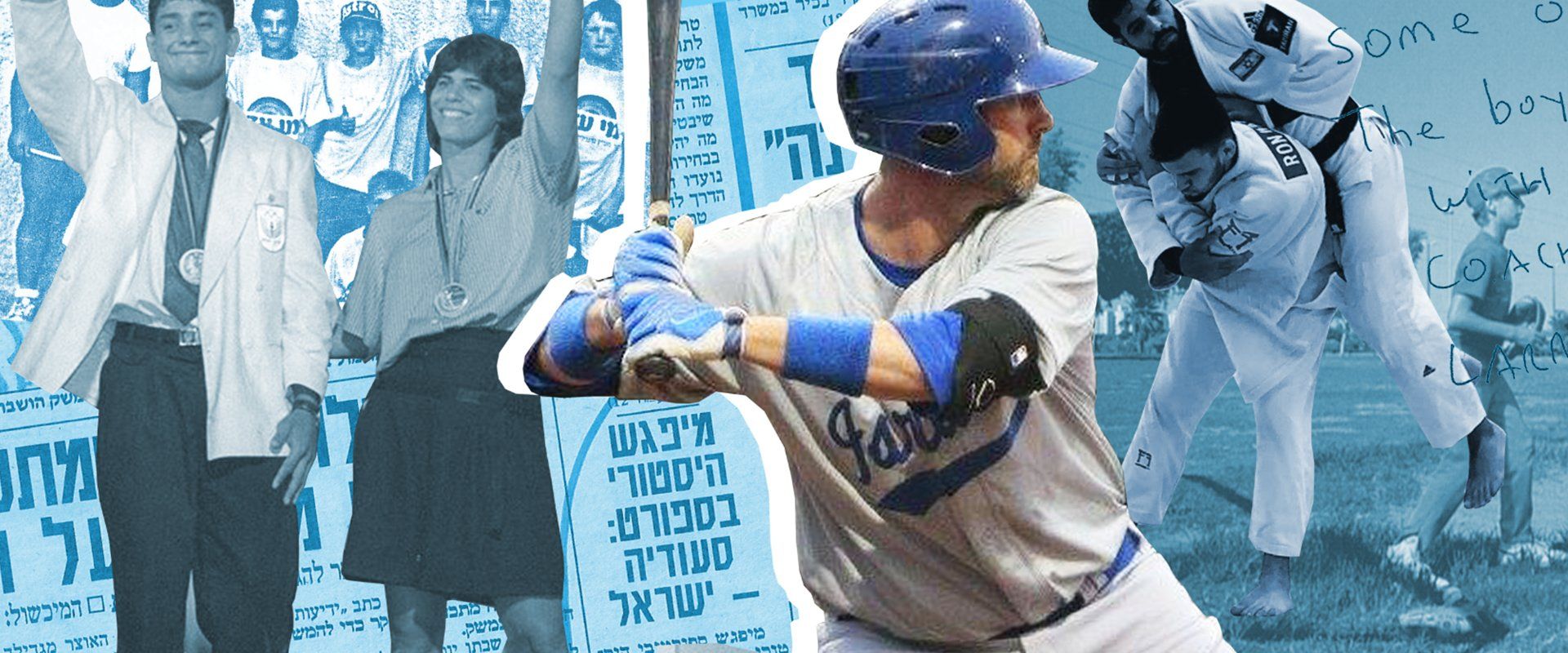
In Barcelona in 1992, after four decades of reliable disappointments, judokas Yael Arad and Oren Smadja made history by becoming Israel’s first Olympic medalists. Their success catapulted a relatively esoteric martial art into a national craze. Today, judo is one of the three most popular sports in the country.
Peter Kurz, a faucet and kitchen sink exporter, saw the lasting impact of Arad and Smadja’s pioneering achievements, and dreamed of doing the same with baseball.
And indeed, in the fall of 2019, a new-look Israeli national baseball team played for a chance to represent the country in the Olympics. This was a big deal, for two reasons: First, only six countries from the entire world would compete in Tokyo, and second, Israelis don’t, by and large, even like baseball. So you might think this Olympic bid is the ultimate underdog story – sort of the Jamaican bobsled team of the Middle East. But it is, ultimately, much more complicated than that. It is a tale that combines heartbreak and jubilation, balances national pride and athletic prowess, and touches upon fundamental questions of leadership, education and belonging.
We go back to the two miraculous days in July 1992 that made every Israeli boy and girl want to become the next international judo champion.
Act TranscriptMishy Harman (narration): 1992 was a meaningful year for me. There were sad moments – my grandfather died, my dog Sunshine died, my favorite basketball player – Larry Bird – retired from the game. But there were also many good – even historical – things that happened that year.
Boris Yeltsin: We shall not fight against each other.
Mishy Harman (narration): Boris Yeltsin and George Bush formally declared the end of the Cold War.
George Bush: The Cold War days are over.
Mishy Harman (narration): More than a billion people around the world watched the Freddie Mercury Tribute Concert, which raised millions of dollars for AIDS research. And the Vatican finally vindicated Galileo.
Reporter: The Pope said the Church was sorry but it was wrong.
Mishy Harman (narration): Admitting that Earth does indeed orbit around the sun.
Reporter: Now the Vatican even has its own astronomical observatory.
Mishy Harman (narration): In Israel, too, it was a dramatic year: In January, for the first time, we established diplomatic ties with China. Six months later, in June, Yitzhak Rabin won the elections, and the Labor Party returned to power. And on July 30th, nine days after my ninth birthday, I – together with basically everyone else in Israel – turned on the Olympics on TV to watch what was till that moment a pretty esoteric sport.
Movie Clip: It is Thursday, July 30th. The judo competition is about to get underway. Twenty-nine women are entered into the one-hundred-thirty-four-and-a-half pound weight division.
Mishy Harman (narration): After a couple of victories in the preliminary rounds, Yael Arad was about to step onto the mat for the women’s semifinals. Her opponent?
Movie Clip: Frauke-Imke Eichhoff of Germany. The reigning world champion. Eichhoff is the favorite of many to win the gold medal.
Mishy Harman (narration): The winner would not only advance to the finals, but also guarantee herself at least a silver medal. Now, I should say that I was watching because Yael Arad was Israeli. The sport itself meant nothing to me. I couldn’t really figure out what the hell was going on or even who was ahead.
Commentator: [In Hebrew] Yael has a waza-ari. The German tried to do a counter-move, but Yael took advantage of the opportunity and performed a throw called ōuchi-gari.
Mishy Harman (narration): But when you come from a small place like Israel, none of that matters. Any Olympic appearance is exciting.
Commentator: [In Hebrew] Who won? Yael or Eichhoff? It’s not clear.
Uri Levi: [In Hebrew] According to the board, I think Yael.
Commentator: [In Hebrew] Yael won!
Uri Levi: [In Hebrew] Yes! Yael got the waza-ari.
Mishy Harman (narration): Yael beat Eichhoff.
Uri Levi: [In Hebrew] First Olympic medal for Israel! And it will be gold or silver.
Mishy Harman (narration): And went on to the finals. She ended up losing the gold medal, in a crushing and somewhat controversial decision. But nevertheless, with her second place finish, Yael Arad became the first Israeli ever to win an Olympic medal.
Yael Arad: Really it’s crazy. You come from a small country and you have the chance to make a history, so this… it’s crazy.
Dan Kaner: [In Hebrew] Yael Arad, the great Israeli hope at the Barcelona Olympics, became – today – a dream come true. Way to go, we are proud of you.
Mishy Harman (narration): The entire country was ecstatic. But there wasn’t much time to celebrate. See, the very next day, another Israeli judoka – twenty-two-year-old Oren Smadja from Ofakim – made it to the bronze medal fight in the men’s under seventy-one kilo category. He was up against the mighty Stefan Dott from Germany. Here’s Oren.
Oren Smadja: Look, Dott was the reigning European champion, and the heavy favorite to win. But I remember stepping onto the mat without any fear. I was there to win.
Uri Levi: [In Hebrew] Kumi kata is a basic hold of the garment.
Commentator: [In Hebrew] Holding the garment.
Uri Levi: [In Hebrew] Yes, ippon.
Commentator: [In Hebrew] Oren, bronze medal.
Uri Levi: [In Hebrew] Yes, ippon.
Oren Smadja: After forty-six seconds I managed to topple him, I raised my hands in the air, and I was an Olympic medalist. It was a really sweet moment for me and for the entire state of Israel.
Uri Levi: [In Hebrew] A bronze medal for Israel. A second medal. We’ve broken through the barrier, and we have a deluge in judo…
Mishy Harman (narration): After forty barren years, we had won our first two Olympic medals in two miraculous days, and both of them were in a sport that – it’s safe to say – most Israelis had never even heard about prior to that week.
Oren Smadja: You know, it wasn’t a popular sport. I can tell you that till 1992, it was all about soccer and basketball. Judo was just an after-school activity.
Mishy Harman (narration): When they returned to Israel, Yael and Oren were national heroes. Thousands of fans were waiting at the airport. They were immediately invited to meet the president and the prime minister. For months, their smiling faces were on the cover of every possible magazine, and the following Purim, of course, they were the most popular costumes. Judo, Yael says, became the hottest thing around.
Yael Arad: From the minute we came back, judo became really something that everyone wanted to touch and try.
Mishy Harman (narration): There was something incredibly relatable about them. According to Moshe Ponte – Oren’s coach at the Olympics – a lot of the appeal was that Oren and Yael were both 100% local. Two homegrown tzabarim.
Moshe Ponte: They born in Israel, they’re speaking Hebrew.
Mishy Harman (narration): They were any one of us. Not so much untouchable Olympians but rather regular people – the kind you’d bump into at the corner store, or at the bank.
Yael Arad: I’m young Yael from Tel Aviv. If I did it, everyone can do it.
Mishy Harman (narration): Suddenly all the kids at school signed up for judo classes, and new clubs popped up in every neighborhood.
Moshe Ponte: It’s become huge in Israel. Really huge.
Mishy Harman (narration): Moshe, who is now the President of the Israeli Judo Federation – says that today there are tens of thousands of Israelis who practice judo.
Moshe Ponte: Sixty-seventy thousand, that’s what we know.
Mishy Harman: And what was it before 1992?
Moshe Ponte: Oh, it was… I think, hundred in all judo in Israel.
Yael Arad: When I started, when I was eight years old there was one club in Tel Aviv.
Mishy Harman (narration): But since then things have come a long way. Judo is now the third most popular sport in the country, trailing only soccer and basketball.
Oren Smadja: And I’m delighted, you know? Today judo is the leading Olympic sport in Israel.
Yael Arad: I think for the Israeli mentality, judo is a very good sport. Because we are warriors, you know? We grow up in this country as warriors, and our attitude to life is very much similar to martial arts.
Mishy Harman (narration): The impact, however, ended up being much broader than just judo.
Moshe Ponte: The ‘92, it was the game changer.
Yael Arad: For the Israeli sport, there was a barrier that no one really believed that we are able to cross it. And once one of us – it was me, but it’s one of us – made it, it proved that everything is possible. And now, every children, every kid, every boy and girl, that start sport in Israel, it drives them to work hard, and I think this is the big change.
Joel Shupack brings us the story of Team Israel, the unlikely national baseball team. From the epic 51-0 defeat in its inaugural game in 1989 all the way to a history-making chilly day in September 2019 in Parma, Italy, we hear from current players, people who were forgotten along the way, and one man who wouldn’t let anything stand in the way of his dream.
Act TranscriptMishy Harman (narration): In the Fall of 2019, the Israeli national baseball team played for a chance to represent the country in the Olympics. Now this was a big deal. And it was a big deal for two reasons. First of all, only six teams in the entire world were going to have that honor. And second: Israelis – by and large – don’t like baseball. Not even a bit. Because, let’s face it – we’re not known for our patience and baseball, well, it’s so slow.
Vin Scully: Sandy backs off, mops his forehead, runs his left index finger along his forehead. Dries it off on his left pants leg. All the while Keen just waiting.
Mishy Harman (narration): It’s like the bumper-to-bumper traffic jam of sports.
Vin Scully: Now Sandy looks in. Into his windup and the two-one pitch to Keen.
Mishy Harman (narration): Long before COVID, our producer Joel Shupack went to Park HaYarkon in Tel Aviv to search for baseball fans. Instead, this is what he came across, again and again.
Man I: How you call that?
Joel Shupack: It’s called a bat.
Man I: Yeah [laughs].
Joel Shupack: Do you know anything about baseball?
Man I: No, not too much really.
Man II: The game is very boring.
Man I: I know there is someone that strike the ball. You know, there is someone else that throw the ball to him.
Man III: The other team try to catch the ball and then they touch the station, how do you call it?
Joel Shupack: The base?
Man I: The base. This is what I know.
Mishy Harman (narration): There are only about a thousand people in Israel who play baseball. That’s kids, adults, fantasy players, everyone. So you might think this Olympic bid is the ultimate underdog story. Sort of the Jamaican bobsled team of the Middle East. But as it turns out, it’s a little more complicated than that. It’s a story that has as many tears of pain as it does of joy. Here’s Joel Shupack with Jews on First.
Announcer: Chilly raw air on a Sunday afternoon, late September, here in Parma.
Joel Shupack (narration): Parma, Italy – a place better known for Parmesan cheese than baseball games. And yet, it is here that some of the best teams in Europe and Africa are facing off for a chance to play in the Summer Olympics. It’s September of 2019, and after four days of fierce competition, two teams are on the field for the last time.
Annoncer: He likes the sign… Taken high!
Joel Shupack (narration): It’s the final inning.
Announcer: There is no tomorrow for these two teams.
Joel Shupack (narration): One of the teams is South Africa. The other wears blue and white uniforms with a Star of David on their hats.
Announcer: Israeli baseball program is come out of nowhere to take the baseball world by storm.
Joel Shupack (narration): The fact that Israel is even in this tournament is a small miracle. But if you think that’s something to celebrate…
Announcer: And now Israel is one strike away from making history.
Joel Shupack (narration): Team Israel is on the verge of winning the whole thing. If they can just close out this last game, they’re going to the Olympics. But this is baseball. Anything can happen.
Announcer: The pitch. And this ball’s flown out to right field. Simon Rosenbaum reaches up…
Joel Shupack (narration): We’ll get back to that game later on, but before we do, I want to tell you about Israel’s first national baseball team. The year was 1989. The entire country had exactly two baseball fields. One of them – I’m not making this up – was actually carved out of a cornfield by American kibbutzniks.
The Voice: If you build it, he will come…
Joel Shupack (narration): Earlier that summer, army tanks and protesters clashed at Tiananmen Square, Nintendo released the Game Boy, and a new sitcom called Seinfeld premiered on NBC. And on the Ramstein Air Base in West Germany, the Israeli national little league team was about to make its world debut.
Dan Rotem from Tel Aviv was eleven at the time.
Dan Rotem: To play on Team Israel, you had to know a little bit of baseball and had a pulse. So I qualified.
Joel Shupack (narration): Pulse, yes. Uniforms? Not so much. This is Shlomo Lipetz, Dan’s teammate.
Shlomo Lipetz: We were all wearing sweatpants with completely different hats. We had shirts that were printed in one of those like mall t-shirt machines.
Joel Shupack (narration): That’s right – the first national baseball team was made up of scrawny preteens in sweatpants. Many of them, like Dan, had only just started playing.
Dan Rotem: I remember one of the coaches hitting a fly ball to me. And I was running in, I was bending over and I caught that ball probably a couple of inches off the ground. And the coach just got so excited. I didn’t even realize I did something worthy. But that was like the first baseball play that I remember.
Joel Shupack (narration): Not only was this Israel’s very first tournament, but the very first game was against an unlikely rival. Saudi Arabia.
Dan Rotem: And they beat us fifty-one to nothing.
Joel Shupack (narration): Fifty-one to nothing.
Dan Rotem: The next day, the Saudi authorities denied the existence of the game.
Joel Shupack: Really?
Dan Rotem: Yeah, I have pictures though, so I can prove that.
Joel Shupack (narration): But that epic defeat didn’t really discourage Dan, Shlomo and their friends.
Dan Rotem: It was such a struggle just to put that team together that we couldn’t care less.
Shlomo Lipetz: At the age of ten years old, eleven years old. I was representing the country. I got to travel.
Joel Shupack (narration): At the end of the tournament they flew back to Israel and kept on practicing. Year after year Team Israel returned to that summer tournament.
Shlomo Lipetz: As long as you could play a little bit ball your spot is kind of secure.
Joel Shupack (narration): And year after year they were clobbered. Forget about winning. It wasn’t till 1992 – three years later – that they even scored a run against one of the other teams.
Shlomo Lipetz: I batted in the first run. I still vividly remember taking the flag, running around the field in celebration. We lost eleven to one, you know, we scored a single run, good for us.
Joel Shupack (narration): So yeah, Team Israel had pretty humble beginnings.
At the time, it would have been almost impossible to think that just three decades later they’d be competing for a spot in the Olympics. And even harder for Dan and Shlomo to imagine that one of them would actually be on that team, while the other would be sitting at home, almost too heartbroken to watch the game.
Both Dan and Shlomo are now in their early forties. Dan lives in Tel Aviv and researches the Israeli-Palestinian conflict for a small think tank.
Dan Rotem: But my mind and my heart are invested more in baseball.
Joel Shupack (narration): He’s tall, with a shaved head and stubble. Honestly he looks like a ballplayer and when he talks about baseball, he just lights up. Shlomo too.
Shlomo Lipetz: I love the game of baseball so much.
Joel Shupack (narration): Shlomo also grew up in Tel Aviv. Nowadays he lives in Brooklyn and organizes live concerts for City Winery, a chain of upscale venues across the US. He looks like a friendly giant. Six foot five, a thick black beard and a mullet. Always smiling.
As far as Israeli baseball is concerned, Dan and Shlomo have always led the way. After they finished their military service, they became the first Israelis to play college baseball in America, both as pitchers. Dan went to Georgia Southern University, and tried his best to fit in with his teammates.
Dan Rotem: Yeah, so I started chewing tobacco like them. I started dressing like them. Old hat with a fishing hook on it. Biscuits, gravy, grits. The whole shebang.
Joel Shupack (narration): And Shlomo to San Diego Mesa College in surfy So-Cal.
Shlomo Lipetz: After the first couple weeks, they went and bought me a bunch of like cargo shorts just so I could kind of mesh in.
Joel Shupack (narration): Following college they each went their own way. But no matter what else was happening in life, every other summer they’d pack their bags and fly to Europe to play in international tournaments for Team Israel.
Shlomo Lipetz: I would look forward to it all year. It would keep me motivated all year to continue practicing and getting into shape.
Joel Shupack (narration): And just like when they were kids, it was never about winning.
Dan Rotem: You get to go on the field in your Israel uniform, play for a purpose with guys that you’ve been doing this for the past fifteen years. It’s magical, it really is magical.
Joel Shupack (narration): But back in Israel, no one really cared.
Shlomo Lipetz: Obviously in Israel, nobody gives a rat’s ass about baseball.
Joel Shupack (narration): Well, that isn’t entirely true. Here’s one Israeli who does give a rat’s ass about baseball.
Peter Kurtz: Peter Kurtz, normal guy. [Laughs].
Joel Shupack (narration): A normal guy whose life is consumed with trying to get more Israelis to play the game.
Peter Kurtz: How much of my day is dealing with baseball? Probably eighty percent but don’t… don’t quote me on that because my wife will kill me. [Laughs].
Joel Shupack: What does she want you to be spending your day doing?
Peter Kurtz: Doing work, doing regular work that I get paid for. I don’t get paid for this and I don’t get paid for the baseball stuff.
Joel Shupack (narration): Peter actually gets paid to export faucets and kitchen sinks. And unlike Dan and Shlomo, he never really played baseball growing up.
He made aliyah from New York almost forty years ago. But baseball? It wasn’t on his mind at all.
He and his wife were settling down in Givatayim just around the time Team Saudi was mopping the floor with Dan and Shlomo. A few years later, their eldest son joined a scrappy little league team and Peter agreed to help coach. Before he knew it, he became president of the IAB, the Israel Association of Baseball.
Peter Kurtz: So you advance very quickly in this organization.
Joel Shupack (narration): I’ll say. Somewhere along the way, he developed the belief that baseball is the key to improving life in Israel.
Joel Shupack: And you actually believe that baseball will make this a better place for people?
Peter Kurtz: Definitely. Definitely. Baseball is the way to do that, is the vehicle for it and for doing that.
Joel Shupack (narration): When I asked him why, exactly, it would be baseball that would accomplish this, he talked about the slow pace, the family atmosphere and, how shall I say, the accessibility of the sport.
Peter Kurtz: You don’t need to be tall. You don’t need to be fast. What’s around the game? You know, not just the game itself, but what’s around the game, I mean hot dogs, obviously kosher hot dogs and everything. They don’t know to put mustard on hot dogs. They know hummus. Fine, that’s OK. Whatever. Whatever they want. That’s the Israeli version.
Joel Shupack (narration): To Peter, what Israel needs most is a sport that the average schmo can play.
Peter Kurtz: More people can play baseball than other sports.
Joel Shupack (narration): Where kids can learn…
Peter Kurtz: How to play together, to learn sportsmanship, to learn leadership. I think all those are important things. And I’m living in Israel to make life better here.
Joel Shupack (narration): But despite these lofty goals, and the countless hours he’s spent trying to promote baseball in Israel, Peter barely moved the needle.
Peter Kurtz: The most incredible game that there could be in baseball is when a pitcher throws a perfect game. Actually during a perfect game, nothing happens. There’s no hits. There’s nothing, you know? But that’s but that’s the most tense game it can be. Trying to explain that to Israelis is very very difficult.
Joel Shupack (narration): To be fair, interest in baseball has been growing over the years. But very slowly. For example, remember how I said that in 1989 there were just two baseball fields in the country?
The Voice: If you build it, he will come.
Joel Shupack (narration): Well today, there’s a whopping… three. Most local enthusiasts resigned themselves to the idea that baseball was, and would always remain, just a tiny sport in a tiny country.
Dan Rotem knew this as well as anyone. Ever since he returned to Tel Aviv, he remained as dedicated as ever. In addition to those summer tournaments with Shlomo and the gang, he also coached and helped organize an amateur adult league.
Dan Rotem: Finishing work early, schlepping your baseball equipment and throughout this, you gotta make phone calls, make sure others come, trying to get everybody to play, otherwise they’ll quit. It’s hard work and it’s not always fun.
Joel Shupack (narration): But the promise of a summer tournament in Europe kept him going.
Dan Rotem: That one week makes the two years prior worth it.
Joel Shupack (narration): He also served on the board of the IAB together with Peter. So in other words, Dan was kind of the pillar of the local baseball scene. And – much like Peter – he too had a vision for how to grow the sport in Israel: Start kids off with a simplified version of the game from a young age, and do so in the most Israeli way possible — by making do with what you have.
Dan Rotem: Even a kickball at the beginning. Something that is very accessible where you can have masses of kids.
Joel Shupack (narration): But Peter was the man in charge. He was the president after all. And his vision was much bigger than kickball.
He thought that baseball would only compete with soccer and basketball – Israel’s most popular sports – if it could enter the big leagues, so to speak. And when he heard that baseball would be reinstated as an Olympic sport in the 2020 Tokyo games, Peter saw his opportunity.
Peter Kurtz: The Olympics is big. The Olympics is big and everybody knows the Olympics and people love the Olympics. But you never think of being there.
Joel Shupack (narration): Peter dreamed of bringing Team Israel as close to that bright spotlight as he possibly could.
This was actually Peter’s second time around the block. A few years earlier he helped put together a team – made up primarily of foreigners – to represent Israel in an invitational tournament called the World Baseball Classic. That team was pretty awesome, but it barely got any coverage back in Israel.
This time, he hoped, would be different. After all, nothing’s bigger than the Olympics.
But like any guy who spends twenty percent of his time dealing with sinks and faucets, Peter is a realistic man.
So he knew that any fantasies he might have of winning an Olympic medal in Tokyo, should be dialed down. Instead he set himself what he thought was a more attainable goal.
Peter Kurtz: And I said my goal is to get the Olympic qualifiers.
Joel Shupack (narration): He just wanted Team Israel to be in the mix.
Peter Kurtz: If we get to the Olympic qualifiers we’ll be known. We’ll be famous.
Joel Shupack (narration): In his eyes, this would be the best chance he’d ever have of grabbing the country’s attention and promoting the sport in Israel.
But the path to that qualifying championship was pretty daunting. Israel would have to beat all the “Israels” of the world – second-rate national teams with no local baseball culture, like Lithuania or Ireland. But they’d also have to defeat the titans – teams like Italy or the Netherlands – who win the European championship year after year. It was a long shot, and Peter knew it. But he also had a secret weapon up his sleeve.
See, according to Olympic regulations, in order to represent a country, you have to be its citizen. That’s how Kenyan sprinters end up running under a Norwegian flag, or Algerians represent England. Citizenship is always a sticky issue, especially when it comes to elite athletes. But in Israel, as you probably know, there’s a Law of Return. And that means that anyone with even one Jewish grandparent can automatically become a citizen. Or in Peter-speak, anyone even partially Jewish was eligible to play for Team Israel.
What if, Peter thought, he could find some great Jewish ballplayers, convince them to get citizenship and join the team? That would certainly improve his chances of getting Israel to the qualifiers.
And, well, if you need Jewish ballplayers, there’s really only one place to look.
While Israelis couldn’t care less about baseball, in America, Jews have always had a special connection to the game. In the early twentieth century, when Jewish immigrants were largely excluded from mainstream culture, baseball was a way in. And since the very beginning of professional leagues, every generation had their own Jewish star. Like Al Rosen or Hank Greenberg.
Archival Tape: The slugging Hank Greenberg is the next batter. Here’s comes the pitch and there is goes.
Joel Shupack (narration): Greenberg famously sat out a World Series game for Yom Kippur and got a standing ovation when he walked into synagogue. And then of course…
Vin Scully: Sandy Koufax, whose name will always remind you of strikeouts.
Joel Shupack (narration): Sandy Koufax. One of the best pitchers of all time.
Vin Scully: He is one out away from the promised land.
Joel Shupack (narration): With that kind of a history, surely Peter could find some Americans to bulk up the local team. But there was one small problem. It’s not like there’s a directory of every Jewish ballplayer.
Peter Kurtz: Finding a Jewish American player in America in the minor leagues is like finding a needle in a haystack.
Joel Shupack (narration): Except that, well, there actually is a directory of every Jewish ballplayer. It’s called the Jewish Sports Review. A pretty niche print magazine run by two guys named Ephraim and Shel.
Peter Kurtz: Two old Jewish guys who scour the Internet to look for Jewish baseball players. I’m not even sure if they’re alive anymore today.
Ephraim Moxson: Jewish Sports Review?
Joel Shupack (narration): Well, it turns out they are.
Ephraim Moxson: Yes, my name is Ephraim Moxson.
Joel Shupack (narration): Ephraim Moxson, age seventy-eight. For the last quarter-of-a-century, give or take, he and his friend Shel Wallman, who’s in his eighties, have collected the stats of virtually every Jewish ballplayer who’s ever lived. Major leaguers, minor leaguers, independent leagues, even college teams.
Joel Shupack: Are you the only people doing this?
Ephraim Moxson: Yep. Nobody else would do this.
Joel Shupack: So OK, so walk me through the process. How are you finding these Jewish players? What are you looking for Jewish-looking names or…
Ephraim Moxson: If you’ve got a guy by the name of Schwartz and he lives in North Dakota, ninety-nine out of a hundred times he’s not Jewish. If you’ve got a Schwartz living in Brooklyn, yeah, you check him out.
Joel Shupack: Why is this important? Why is this important to you?
Ephraim Moxson: We always wanted to know who was Jewish.
Joel Shupack (narration): They just always wanted to know who was Jewish. As simple as that…
Anyway, Ephraim and Shel’s encyclopedic work slash obsession, made life easy for Peter. All he had to do was start making calls. And even that didn’t last long. Pretty soon word spread about Team Israel and Peter stopped having to look altogether.
Peter Kurtz: I get emails every day from potential players. “I’m playing minor league baseball,” or “I’m playing high school.” I got a letter from a parent he said, “my kid is twelve years old, and my kid is really good.” You wouldn’t believe it.
*****
Mishy Harman (narration): Two events shaped the life of young Peter Kurtz. In June 1967, his parents took him on a trip to Israel. It was two weeks after the end of the Six Day War and the Kurtzs visited the newly-liberated Western Wall.
Peter Kurtz: Thousands of people were there praying. So that was when I was ten years old. That made me a Zionist.
Mishy Harman (narration): And two years after that, in 1969…
Peter Kurtz: The New York Mets won the World Series, the ‘Miracle Mets.’
Mishy Harman (narration): Fast-forward fifty years and that same sense of Zionism and baseball fever brought Peter to dream up a new, and highly unusual, idea – an Israeli national baseball team made up of Jewish Americans. Here’s Joel.
Joel Shupack (narration): Not everyone was in love with Peter’s new idea. Sure, maybe it would make the national team better. But would it actually help grow the sport in Israel? Dan had serious doubts. So he proposed a compromise.
Dan Rotem: I told him, “you can recruit American players, but on the condition that you come to Israel for a year or two to develop the sport here.” He wouldn’t hear anything from it.
Joel Shupack (narration): Instead Peter barreled on with his grand plan. And he didn’t really need Dan’s approval. Besides, there was no shortage of guys who were willing to come help the team. A few of them had even played in the major leagues.
Peter Kurtz: Some for just a cup of coffee, some for longer, and you’ve got ex-minor leaguers.
Jeremy Wolf: I thought my career was over, until Peter calls.
Joel Shupack (narration): Like this guy, Jeremy Wolf.
Jeremy Wolf: I’m Jeremy Wolf. Former New York Met minor leaguer.
Joel Shupack (narration): Jeremy’s short career ended when a disc slipped out of his back before a game in Brooklyn.
Jeremy Wolf: Yeah, so I was running and then it just popped right out.
Joel Shupack (narration): But he was on Peter’s radar.
Jeremy Wolf: He’s like “do you want to play outfield?”
Joel Shupack: Was that a total shock?
Jeremy Wolf: A hundred percent, yeah. And I’m only half Jewish! My mother’s Italian, my mother’s Catholic, which is… which is why I’m in therapy.
Joel Shupack (narration): Therapy or not, he was Jewish enough for Peter, and Jewish enough for the State of Israel. In order to play though, Jeremy and the other new guys, actually had to make aliyah, to come to Israel and become citizens. But for a chance to play on a national team, it was worth it.
Jeremy Wolf: I got teased a lot growing up for being like one of the Jews, right? And so now I get to be a role model for the rest of the Jewish players. This is my way of giving back, it’s through the only thing I’m pretty much good at.
Joel Shupack (narration): Some of the recruits, like Jeremy, had thought their careers were already over. Others had been grinding it out for years in less glamorous independent leagues for little money.
Joel Shupack: So what does it mean to you to be able to play again?
Jeremy Wolf: Means everything.
Joel Shupack (narration): Israel’s road to the Olympic qualifiers started on July 1, 2019, in – of all places – Bulgaria. There, they’d have to win the first of three preliminary tournaments. Technically, the whole team was Israeli, but it was made up of two groups: Half were the American newcomers, and half were the original Israeli players, including Dan and Shlomo.
It was the first time many of them had played together.
Jeremy Wolf: I’ve been around really good teams, and I’ve been around really bad teams, and this Team Israel had… had something about it… Something bigger than baseball.
Joel Shupack (narration): Jeremy and some of the other Americans noticed that Israelis seemed to have a unique way of playing the game.
Jermey Wolf: ‘Israeli-style baseball.’ They don’t think, right? In America, like, you’re very cautious, you have to see like your next steps. Israelis they go, “I don’t think at all, I just play.”
Joel Shupack (narration): But culture shock aside, the new hybrid team dominated against Bulgaria, Serbia, Greece and Ireland. None of those games were even close. But, in order to keep the dream alive, they still had to beat Russia.
Shlomo Lipetz: The Russians were the team to beat.
Joel Shupack (narration): Before the deciding game with Russia, Team Israel stood in a line for HaTikvah, the Israeli national anthem. Some of the new players didn’t really know the words. Late in the game Russia was ahead. But then…
Shlomo Lipetz: They put in this pitcher who walked three guys and hit a guy, and…
Joel Shupack (narration): Before they knew it, Israel came from behind and won its first tournament. Everything seemed to be going according to Peter’s plan. But Israel still needed to win two more tournaments. And Peter wasn’t going to leave anything to chance.
Peter Kurtz: Because we just… I just couldn’t afford to… I really wanted to have the team always be sabras, but I also wanted to win.
Joel Shupack (narration): As more and more talented Americans lined up to join the team, even the best Israeli players – like Shlomo – had to face a new reality.
Shlomo Lipetz: There are probably players that are much, much better than you that now actually are qualified and could play.
Joel Shupack (narration): As happy as they were about the new-found international success, they didn’t even know if their own place on the team was secure. Here’s Dan.
Dan Rotem: Yes, Peter was unwilling to commit to anything.
Peter Kurtz: I want to be as loyal as possible to the players and the coaches that I can be. But I also want to improve our chances of winning. And it means hurting some people’s feelings. And that’s one of the hardest parts of a job of a general manager.
Joel Shupack (narration): With each round of games, Peter added more and more Americans to the team. And that meant that more and more Israelis were kicked off.
Unsurprisingly, perhaps, it worked. Team Israel just kept winning. But the “Israeli-style baseball” that Jeremy talked about, was becoming a smaller and smaller part of the Israeli team. Dan had a hard time understanding how any of this made sense.
Dan Rotem: Now the national team, the thing that motivates such a core group, is taken away. How does this connect to growing the baseball in Israel?
Joel Shupack (narration): And sure enough, before long, even Dan’s spot on the team was in jeopardy.
Dan Rotem: Peter called me before the tournament and said “we’re not sure yet.”
Joel Shupack (narration): He told him he was trying to recruit a former Major League pitcher named Bleich.
Dan Rotem: “We’re not sure if we can get him to Israel to get his passport in time for this.”
Joel Shupack (narration): If Bleich came, Dan would be out. But if it all fell through, he would keep his spot on the team.
Dan Rotem: So there were a few days [laughs], I was really hoping, almost praying.
Joel Shupack (narration): It was all he could do. Finally, his phone rang. It was Peter.
Dan Rotem: And then he said, “we’re gonna get Bleich there so… thank you. Goodbye.”
Joel Shupack (narration): That was the whole conversation.
Dan Rotem: It was maybe a minute.
Joel Shupack (narration): Dan – who had been on Israeli national teams since that first tournament in 1989 – was heartbroken.
Dan Rotem: For every one that was flown to Israel, spent a few days here, was given a passport and told him “congratulations, you’re now Team Israel,” there’s somebody who was told “you’re no longer Team Israel,” OK? And these are key guys that made the program here work. Ultimately including myself.
Joel Shupack (narration): There were now just four Israelis left. One of them was Shlomo. At the next tournament it soon became clear that Peter’s dream had come true.
Peter Kurtz: We won our first few games and then we beat France. So we knew we were going to the Olympic qualifiers.
Joel Shupack (narration): But perhaps, they began openly wondering, they could do even better.
Peter Kurtz: I just wanted to get to the Olympic qualifiers. And then I realized, you know, you want more. Whenever you go forward, you want more.
Joel Shupack (narration): If they could just keep it up, and win a few more games, they’d actually go to the Olympics.
Announcer: Chilly raw air on a Sunday afternoon, late September, here in Parma.
Joel Shupack (narration): It all came down to that game in Parma, Italy, the one that started off our story. It was the final game of the tournament and a win would send Team Israel to Tokyo.
Even though the stakes were so high, no Israeli TV station aired the game. Instead, it was streamed on YouTube. Fans, including Dan – watching from his home in Tel Aviv – were chiming in in the comments section. Early on, an old friend of his typed, “why aren’t you there with our boy Shlomo? You’re one of the originals.” Dan just wrote, “ouch. Big ouch.” He didn’t say much more after that.
Now, I’d like to say that the game was close. That some heroic play in the bottom of the ninth inning changed everything. But this just wasn’t one of those games.
Announcer: Israel ahead by ten. Eleven runs on eight hits as they held South Africa to just one run.
Joel Shupack (narration): In the last inning, with Israel one out away from winning, Dan watched as his old friend and teammate, Shlomo Lipetz, was called into the game.
Announcer: Look at the forty-year-old right-hander Shlomo Lipetz who comes in…
Joel Shupack (narration): He was the only native Israeli on the field.
Shlomo Lipetz: You know I didn’t really put a meaning, I think me being the symbol of Israel baseball, it’s all symbolic. I was just, just happy to be there.
Joel Shupack (narration): Shlomo, who could remember playing for the national team in sweatpants, now had a chance to send his country to the Olympics.
Announcer: Lipetz on to try and get the last three strikes. He deals with Dale Feltman. His first pitch just missed the inside for ball one…
Joel Shupack (narration): Dan never told me this directly, but I assume it would have been hard for him not to imagine himself up there on the mound. What he did say was that he was happy for his friend and for everyone else wearing a Team Israel uniform.
Dan Rotem: Really I have dear friends on this team and I want nothing but success for them.
Joel Shupack (narration): He watched as one South African batter got on base.
Announcer: Shlomo Lipetz set and ready. Ground ball hit to third, knocked down by Penprase and the game will continue.
Joel Shupack (narration): And then…
Shlomo Lipetz: I’m about to throw the pitch.
Announcer: The pitch. And this ball’s flown out to right field. Simon Rosenbaum reaches up and that’s the out that ends it! We can say it, it’s official: Next year in Tokyo! Israel’s going to the Olympic games!
Joel Shupack (narration): On the field, it was pandemonium.
Shlomo Lipetz: And I’m just like jumping up and down. And then just such genuine happiness. Like everyone’s like just looking each other, giving just genuine loving hugs. Telling each other we love each other. Now we could say it out loud, “we freaking made it to Tokyo.”
Joel Shupack (narration): Peter had accomplished the impossible.
Peter Kurtz: I had tears in my eyes. I was there on the side with my son, who was with us.
Joel Shupack (narration): The YouTube feed was blowing up with comments – excitement, congratulations, disbelief. But Dan remained quiet.
Joel Shupack: Are you excited at some level that Israel will be in the Olympics?
Dan Rotem: I’m still too hurt.
Joel Shupack: Yeah.
Dan Rotem: To be excited. I mean I am going to watch the game, just like I watched the qualifying rounds. But the whole enterprise is too… is too painful.
Joel Shupack (narration): From the start, Peter had been clear about his motivations.
Peter Kurtz: I’m not doing this to put a team together of Jewish American players to win a gold medal in the Olympics. That’s not my goal. You know, that’s a byproduct of what we’re doing. But the main goal is to increase baseball in Israel, to grow baseball in Israel.
Joel Shupack (narration): In the end, Team Israel achieved everything Peter could have hoped for and then some. Which leads to a very important question – did it actually work? Well, not according to Dan.
Dan Rotem: Look, after Israel qualified, if you actually count numbers you would stay in the single digits in how many people joined, if at all. You didn’t see any bump in registration of kids. Nothing.
Joel Shupack (narration): And that’s not just sour grapes. He’s objectively right. I checked with Peter.
Peter Kurtz: Unfortunately, the numbers are not there and surprisingly. I really don’t know how to explain that, why the numbers are not there. I think baseball all over the world is going down. That doesn’t help me too much to know that, because here in Israel I want it to go up.
Joel Shupack (narration): But both men somehow remain optimistic. Peter still believes the kids will come. And Dan? He has his own dreams.
Dan Rotem: In twenty years, I hope I will be leading the Israeli national baseball team for its competition in Europe.
Joel Shupack (narration): He sees himself the way he always has. As a ballplayer.
In January 2020, right before COVID came into our lives and upended everything, Peter flew in some of the Team Israel players from their homes across America to Israel, the country they represent. They put on a couple PR events. One was to meet the kids.
Team Israel Player: You, how do you throw a fastball? Show me.
Joel Shupack (narration): It was raining, so everyone relocated to an indoor gymnasium in Ra’anana. About a hundred kids spread out along the wooden floorboards with their gloves and ballcaps. In each corner a different member of Team Israel was leading a baseball drill – fielding fly-balls, base-running, pitching grips. As I expected, most of the kids were American or had American parents. Unfortunately, some of them were Yankees fans.
Joel Shupack: Jews aren’t supposed to like the Yankees, they’re supposed to like the Mets.
American Kid: No, nobody likes the Mets.
Joel Shupack: It’s the Mets…
Joel Shupack (narration): But quite a few of the kids, just like Dan Rotem, were born here and had Israeli parents.
Joel Shupack: What’s your name?
Ori: Ori. It’s my first year so I’m still learning the rules and it’s very fun.
Israeli Kid: I got this movie from aunt which is ‘The Sandlot’ and like it really inspired me to play.Joel Shupack: Did you know that there was baseball here before that?
Israeli Kid: No, I’ve never even heard about baseball.
Joel Shupack (narration): Some of the kids had perfect matching uniforms and brand new gloves. Some, I was happy to see, were wearing sweatpants. At the end, the players signed autographs.
Kid: Thanks.
Team Israel Player: No problem. Practice at home guys.
Joel Shupack (narration): And Danny Valencia, the biggest star on the team, impressed all the kids by calling up his big league buddies on FaceTime.
Kids: Heeeey!!
Joel Shupack (narration): At nine o’clock, when it was supposed to be over, baseballs were still flying all over the place. No one wanted to go home.
A couple days later, Team Israel was gone. Gone from the country they play for and back to where they live.
All that was almost exactly a year ago. In late March, of course, the Olympics were postponed because of the pandemic. As we record this, they’re scheduled to begin in July, but it’s unclear whether that will really happen.
If they do, the world will be watching as a scrappy team of has-beens and wannabes takes the field with “Israel” written across their chest and a Star of David on their hats. Shlomo will probably be one of them. Dan will be home. Watching.
What happens next is anyone’s guess. It’s baseball. Anything can happen.
Joel Shupack scored and sound-designed the episode with music from Blue Dot Sessions. Sela Waisblum created the mix. Thanks to Asaf Bar Yossef, David Leichman, Alon Leichman, Ophir Katz, Zach Penprase, and many other members of Team Israel – past, present and future – whom we talked to while working on the piece. There’s a lot more about Israel and baseball that we weren’t able to include in this episode. If you’re interested in the topic, check out the films Holy Land Hardball and Heading Home. As always, thanks also to Esther Werdiger and Wayne Hoffman from Tablet Magazine, and to Sheila Lambert, Erica Frederick, Jeff Feig and Joy Levitt. Finally, a special thanks to Clara Fuhg, Michael Vivier and Alicia Vergara – our wonderful production interns – for their incredibly hard work, dedication and thoughtfulness throughout the season.
The episode’s end song is Lifney She’Yigamer (“Before it Ends”) by Idan Raichel.