
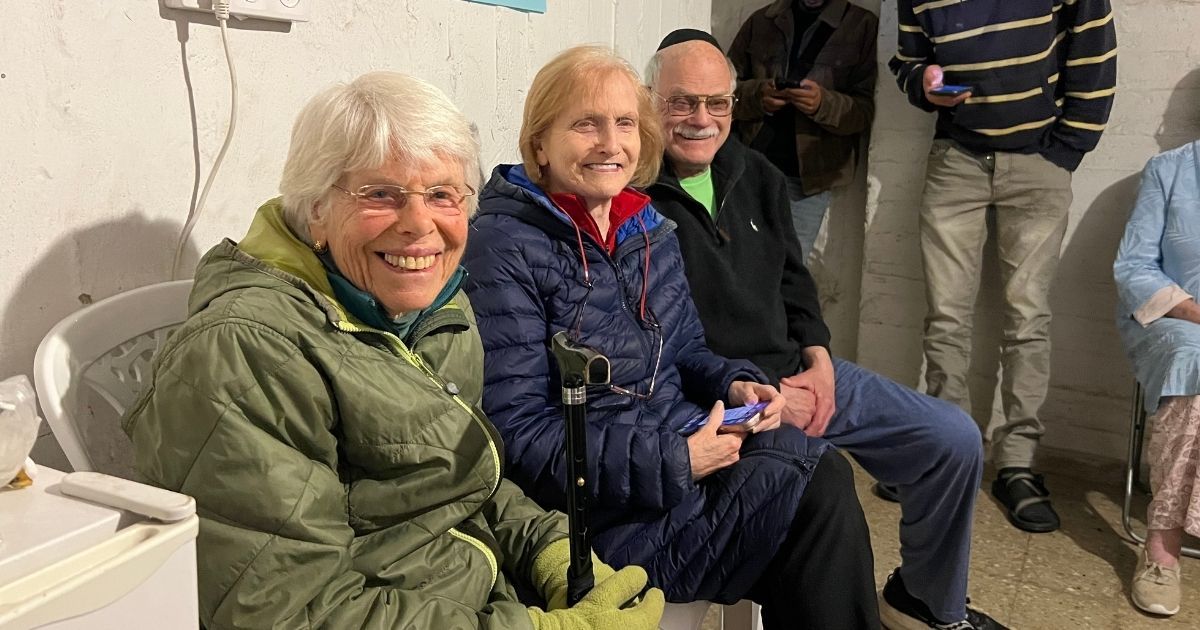
Carol Ginsburg is 83 years old. Her little sister, Grace Lauber, is 77. For decades they’ve lived an ocean apart and have grown accustomed to the distance. But the outbreak of the war caught Grace on a visit, and – for the first time in over 60 years – they found themselves living under the same roof. The sisters chafed and chided, reminisced and bonded. This is the (small) story of their war, and a glimpse into the altered reality that so many of us have experienced during this latest – and grueling – forty-day war.
What’s it like for two sisters, straddling the ninth decade of their lives, to suddenly find themselves as unexpected roommates during a war?
Act TranscriptMitch Ginsburg: You’re feeling very big sister-y?
Carol Ginsburg: Yeah.
Mitch Ginsburg: What does that entail?
Carol Ginsburg: Ummm… suggesting things.
Grace Lauber: Telling me what to do. Not suggesting.
Mitch Ginsburg: Suggestions but with an exclamation point.
Grace Lauber: Yes.
Mitch Ginsburg: Like what? Like when to eat?
Carol Ginsburg: No, when to eat is clear.
Sol Lauber: It’s what to eat.
Carol Ginsburg: Ah, no, no, no, it’s more like, um, being pro-active about finding a flight, getting on a flight, because it’s a competitive game and you have to somehow initiate certain actions in order to get on an El-Al flight when they’re not begging for customers.
Mitch Ginsburg: And you know about such things?
Carol Ginsburg: Well I… it’s just instinct that you should do something.
Mitch Ginsburg (narration): The slightly bossy big sister there is my mother. Maybe it’s a sign of the times and maybe just her natural inclination to avoid the personal, but when I asked her to introduce herself she didn’t mention any of the normal introductory material – you know, name (Carol Ginsburg), age (83), occupation (retired kindergarten teacher). Instead, she immediately focused on her miklat, or bomb shelter.
Carol Ginsburg: Hi, I live in a building in Jerusalem, has a very big miklat. There are eight families in my building but the whole neighborhood likes our miklat and so a lot of them come into our miklat when there’s a siren.
Mitch Ginsburg: OK, and do you want to add that you’re my mother?
Carol Ginsburg: OK, sure, on the record, I’m Mitchell’s mother.
Mitch Ginsburg (narration): Now, my mom’s a lot of things. She’s a life-long student, a beacon of common sense, and has a steady hand on the wheel. But she views publicity as being in poor taste and the discussion of any kind of feeling – really – as, well… gauche. So getting her to sit in front of a mic took some corralling. We’ll get to that, but first let’s meet the rest of the crew.
Grace Lauber: Hi, I’m Grace Lauber, I’m Carol’s sister, Mitch’s aunt from New York.
Mitch Ginsburg (narration): And, sitting right beside her.
Sol Lauber: I’m Sol Lauber, Mitch’s uncle, visiting, indefinitely.
Mitch Ginsburg (narration): For most of the first fourteen years of my life, I grew up living across the street from my aunt and uncle, on either side of Radnor Road in Queens, New York. Their narrow driveway was my basketball court, their living room my theater. When I was a kid, we were all quite close. My uncle, I recall, showed me how to take someone down with a forefinger pressed against their upper lip. This never came in handy, but I kept it as an option in my back pocket anyway. My aunt, who is six years younger than my mom, fed me barrels of rice pilaf. This also didn’t serve me all that well over the years, but I fondly recall the many Friday night dinners we spent together back in the 70s and 80s. Until we packed up our house and left, almost overnight, to Israel. The decision – which I protested heavily at the time – was sudden and final. I wanted to stay with my friends and continue to play stickball in the park. But instead I found myself in Jerusalem, attending a religious day-school in a language I didn’t really know all that well. Since then I never really left – I served in the army, started my life, raised four Jerusalemite kids. But the relationship with my aunt and uncle was never the same. Despite their occasional visits, phone calls and birthday cards, the number of days we’ve spent together can probably be counted on two hands.
Until now. Until this war. Or maybe, I should say, until my dad – Herbie or Zecharia – died in late January. Here’s my aunt Grace again.
Grace Lauber: I was shocked at hearing of Mitch’s father’s death. It was so sudden, so unexpected, and I felt very bad that I wasn’t there for my sister and particularly bad that I wasn’t there for the shiva. So I decided to come for the shloshim.
Mitch Ginsburg (narration): That was on February 23rd. They were supposed to stay for a week and a bit. But five days into their visit, on February 28th, we woke up to this.
[Mash Up]
Mitch Ginsburg (narration): Life here changed immediately. No school, no gatherings of over fifty people. And also, of course, no flights out.
Grace Lauber: And now we’re kinda stranded here, hoping for the first flight out.
Mitch Ginsburg (narration): So there they were, the two elderly daughters of refugees from 1930s Vienna, hemmed in by the Home Front Command’s instructions and yo-yo-ing up and down the stairs, carefully clutching the bannisters on the way down to the bomb shelter. But more than being traumatic, it seems like my aunt and uncle were slightly enjoying all the action.
Sol Lauber: We did not anticipate that Shabbat morning that the sirens would go off and we’re all running down to the miklat. But the miklat is, instead of something that is depressing or fearful, is a social event.
Mitch Ginsburg (narration): My Uncle Sol spent a year here in 1969 and has – sorry, Sol – been talking about it ever since. So being trapped here in the country during a war is – secretly I think – not such a disaster for him.
Sol Lauber: You know, everybody in the area is there. You have older people, younger people, babies, dogs, and it’s nice to meet the neighbors.
Mitch Ginsburg (narration): My Aunt Grace also seemed more or less fine, admiring the respectful culture of the commandment “vehadarta pney zaken” – “thou shalt stand in the presence of the aged” – that she encountered in the miklat.
Grace Lauber: There were always these three chairs that we would sit on. And no matter how late we came because we were slower than the rest–those three chairs were waiting for us. Which I thought was really respectful, yeah.
Mitch Ginsburg: But then, as the days piled up, the excitement dwindled. There were, to be sure, some moments of levity. Five days into the war, for instance, we all celebrated Purim in the bomb shelter. Here’s my mom again.
Carol Ginsburg: One young man said he would be glad to read the megillah for everybody, and I remember that I had the parchment version of the megillah and so I offered him that and he was very happy to accept and since we were such a big crowd and everybody was interested we decided we would arrange chairs in the parking area right outside the miklat and have a fresh-air reading and should there be an alarm we would just go inside and finish the job. And it went off really nicely, really festively. He read beautifully everyone sang afterwards. It was a lovely evening.
Mitch Ginsburg (narration): Suddenly finding himself as the man of the house, Sol, my uncle, did his best to fill in with all kinds of things my dad used to do. Some kiddush, some havdala, some reaching up to the high cabinets. And my mom, I think genuinely, appreciated it.
Carol Ginsburg: Well, my brother-in-law’s been very helpful. Actually gallant. Happy to do all the jobs that I cannot do right now. Heavy lifting and so on. So it gives me an opportunity to see him in a new way – as a helper.
Mitch Ginsburg (narration): But just like any complex sibling dynamic, living side by side again brought back old tensions of the sort that can be brushed off when separated by several continents.
The two sisters have always had a complicated relationship – loving but distant; alike but seemingly at odds. Recently, during the course of this visit, I remembered how, when I was little, my mom would refer to her younger sister Grace as “Lenny” – after the slow-witted character in Steinbeck’s devastating Of Mice and Men.
But here they were, two sisters straddling their ninth decade of life, living under the same roof for the first time since JFK was elected to office. And with my mom newly widowed and having to now use a walker to get around, there was a real role reversal going on.
Carol Ginsburg: It’s always been the other way around. I’ve come to help her. I have solved her problems. It’s just natural. It started very early in childhood, I’m older. So I had been through many of the things that were troubling her and it just became a habit that she would turn to me when she had troubles and I would work on the solution.
Mitch Ginsburg (narration): But now things were different. And change is, well… hard.
I got into the habit of visiting the trio – my mom, aunt Grace and Uncle Sol – most every night, and have been carefully observing the subtle ways in which their relationship was shifting, with a war being waged across our wintry skies and in the wake of my father’s death.
As usual, nothing was said. Nothing was made explicit. Because – see – in my family, at least, more or less any display of emotion is off limits. Even proclamations of love are frowned upon. Not to mention the occasional jab or gentle sleight, or the suddenly visible vein of jealousy between, say, two sisters.
So I asked my own sisters, nieces and nephews and a handful of cousins whether I should “go there.” Into the rocky terrain known as Carol and Grace. Their answers were a firm “nay.” One of them suggested that it would be “incriminating” – that’s actually the word he used. Others weighed in with voice memos.
Family Member 1: Aha. Yeah, not touching that.
Family Member 2: N… No comment from me at this time.
Family Member 3: There is no way I’m getting involved in any of that.
Mitch Ginsburg (narration): My older sister Eve, the resident psychologist, who was boldly the only one willing to use her own name, said she thought the matter was largely generational, and that feelings that aren’t discussed tend to harden. So, taking all that into consideration, I waded in gently.
Mitch Ginsburg: When were the two of you the closest?
Grace Lauber: If you ask her she’ll say never.
Carol Ginsburg: When she was very young. Really!
Mitch Ginsburg: Before she could talk?
Carol Ginsburg: Really, she was an adorable baby, I remember.
Grace Lauber: She drew the line there.
Mitch Ginsburg: And what about you? When do you remember the best times?
Grace Lauber: I always felt I was very close to her. Always.
Mitch Ginsburg: Hmmm.
Grace Lauber: Always looked up to her and always felt protected when I was with her. I can still remember being very young and at one point my mother left us with this very old lady as a babysitter and although I was very young I realized this was not a good babysitter for us, it’s not safe. But I knew that Carol was there and so I felt safe and protected. So I always felt close to her despite the fact that it was not in return.
Mitch Ginsburg: You told me recently that really… you cried when she got married.
Grace Lauber: Oh my God, I was in a state of mourning when she left.
Mitch Ginsburg (narration): Over the years, Grace had always sought to be near my mother.
Grace Lauber: I followed Carol everywhere she went. When we first got married I went to Queens, a neighborhood close to where she lived.
Carol Ginsburg: Also across the street, practically.
Mitch Ginsburg: Oh, I didn’t know that.
Grace Lauber: Yeah. She moved to Kew Gardens, we lived at the tail end of Forest Hills and then moved to Kew Gardens, so we moved everywhere she moved and we stopped… until the aliyah.
Sol Lauber: Well, the Kew Gardens I think was just opportunistic. We found a great apartment that just happened to be a few blocks away.
Grace Lauber: It didn’t happen to be, that’s crazy.
Mitch Ginsburg: That’s what she told you.
Grace Lauber: Boy, that’s off.
Mitch Ginsburg (narration): After we moved to Jerusalem, the two sisters maintained regular phone contact, but the distance, to me, seemed only to grow.
I was secretly hoping, I think, that this forced co-habitation might be an opportunity, late in life, to mend the unspoken, decades-long, clash of personalities. We discussed, without really discussing.
Mitch Ginsburg: Are you keeping the house clean?
Grace Lauber: I’m trying! I’m working hard at it. I’ve been given directions and if it’s not a direction it’s a clue.
Mitch Ginsburg: Like what?
Grace Lauber: I see clues.
Mitch Ginsburg: Like Post-It notes? What kind of clues?
Grace Lauber: No… I’m leaving the dishwasher open so you see it. Please put away the dishes. Which I’m happy to do, but those are clues.
Mitch Ginsburg (narration): There were other subtle clues and surreptitious sentiments. My mom, for example, often calls her little sister “Gracie,” but, as Grace told me…
Grace Lauber: If I’ve done something that she… like dropped water on the floor, it’s “Grace.”
Carol Ginsburg: Boy, a psychologist would have fun with this.
Mitch Ginsburg (narration): But by the end of the visit, I did sense a real shift.
My mom didn’t show emotion, but her tone, at least to my ears, was softer.
Carol Ginsburg: It’s an interlude where you’re forced beyond your expectations to be in a place and to use it as an opportunity for spending time together, going out together, enjoying things together, meeting people together, and sort of taking part in each other’s lives.
Mitch Ginsburg (narration): Last week, after finally realizing that their Air France tickets were not ever going to get them out of here, Grace and Sol managed to get an Israir flight to Athens. Shortly before she left, I cornered her in my childhood bedroom and was touched to see that despite the trouble of being here during a war, she was thinking mostly of my mother.
Grace Lauber: Well, there’s a piece of me that’s sad to leave her alone. I worry about her, particularly as she’s a very avid walker and with the sirens it’s difficult for her – I’m sure – to get into a safe place, and I’m very concerned about that and disturbed that I kinda have to leave… and I’m sad at the whole situation.
Mitch Ginsburg (narration): Tears started to well up in Grace’s eyes.
Grace Lauber: And I could cry so… Yeah, I feel bad that we’re not together. I felt bad from the onset and now I feel even worse. Because she’s vulnerable and I’m not there with her. And it’s really sad to see, although she’s managing I know she’s gonna be lonely, I know it won’t be easy for her, and I’m far away…
Mitch Ginsburg (narration): My mother didn’t hear Grace say all this. She was safely in the other room doing her online exercise class with Shlomit, the fitness instructor.
But as Grace was getting ready to go, packing her bags and checking her reservation for the twentieth time, I sat down with my mom, and asked her to reflect on the imposed quarantine. Was there anything, I asked, that she wanted Grace – or Gracie – to hear when the piece came out?
To my surprise, she spoke freely and poignantly.
Carol Ginsburg: Well, we were thrown together and I would convey to her a sincere thanks because of her willingness first of all to be with us for this terrible period and to attend the shloshim in memory of my husband. Also I would tell her my sincere thanks for all her help and good will and desire to make my life as comfortable as possible and suggestions for future for me and thoughtfulness.
Mitch Ginsburg (narration): I wanted to know if traveling together through this strait of war and confinement had given my mother any insight into her younger sister’s internal world.
Carol Ginsburg: She has always wanted to share my life and I have always not been so willing to share my life, like I really lead my life kind of privately. But here she was in the house and along with me on what I did, including whom I met and what we talked about and what we studied and what we enjoyed.
Mitch Ginsburg (narration): She pondered that for a moment and then added, with a bit of a glint in her pale blue eyes:
Carol Ginsburg: I knew a lot about her and she’s always wanted to know exactly what I do and what I think and what I like and now she knows a lot more, yes, but not everything…
Mitch Ginsburg (narration): OK, Grace, Ma – I’m saying a not-so-silent prayer here that you haven’t listened all the way to this point. But if you have, I want to say something that we usually don’t say in this family: I love you. And I loved spending the intense days of this war together. It’s something I will cherish.
Ugh, my mom’s gonna hate that even more…
This episode is dedicated to the memory of Mitch’s dad, Herbert Ginsburg, who passed away – at the age of 90 – back in January, and is sorely missed by us all.